


Fused glass on a memorial — what it is and what it gives the stone
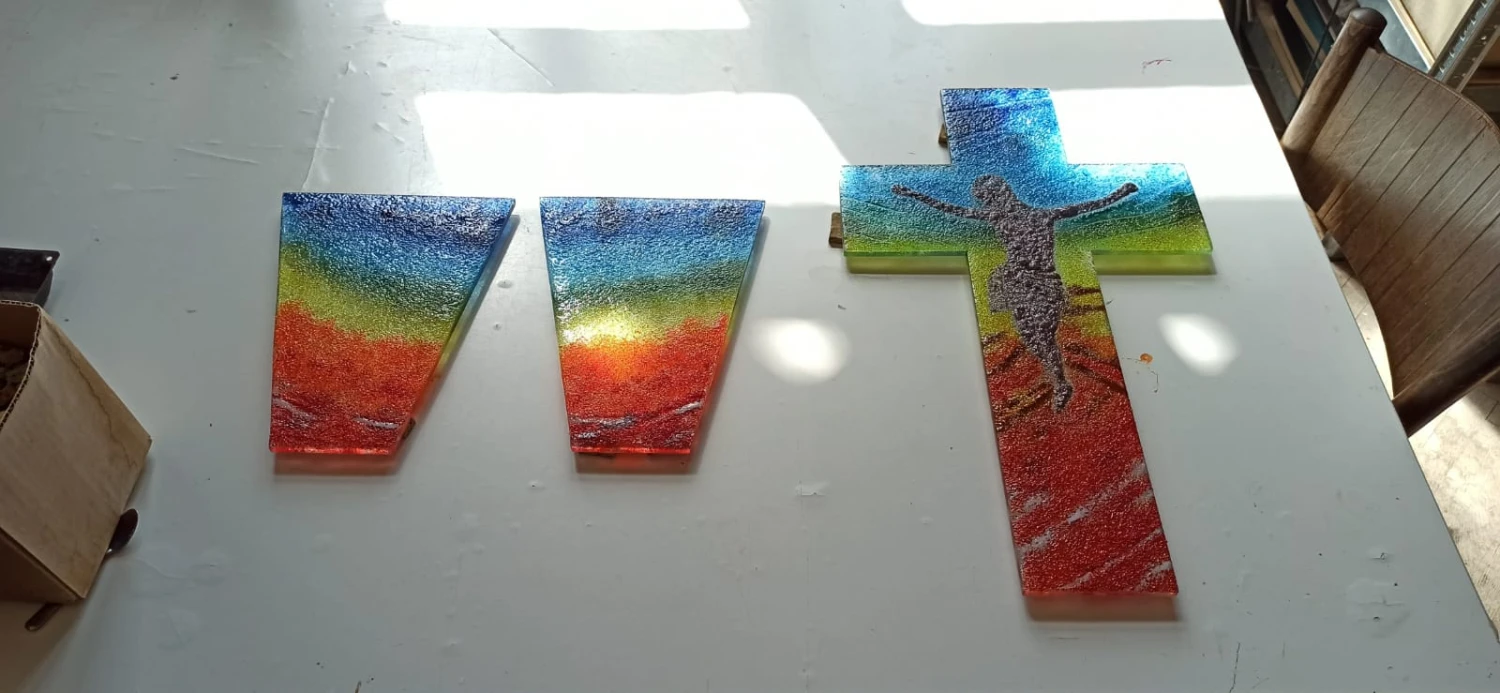
Colour melted into the body, not laid on the surface. How it is made in a kiln, and what decides whether it survives in a cemetery.
Contents
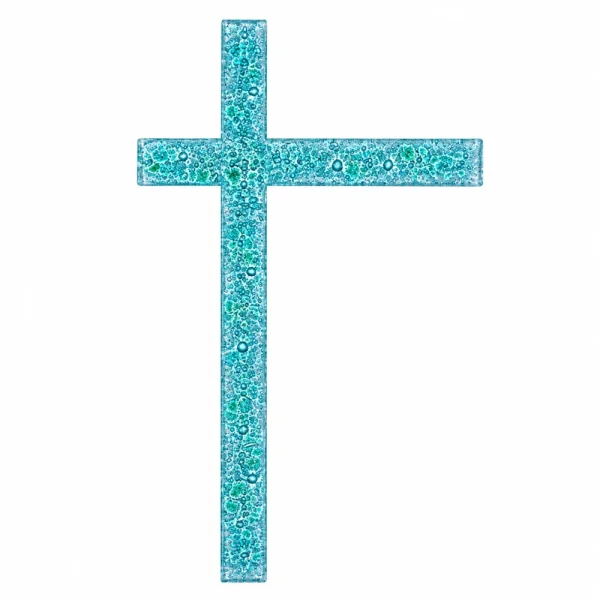 Crosses in fused glass
Stone in a cemetery speaks in one tone. Granite is durable and serious, but it does not change — it looks the same at dawn and at dusk. Glass behaves the other way round: it lives on light, saturates in the sun, goes quiet on an overcast day and comes back the next morning.
That is why it turns up more and more often on memorials, as the element that breaks the weight of the stone. But “glass” covers several quite different techniques, and only one of them puts colour inside the body of the material rather than on its surface. It is called fusing.
Fusing: glass melted together in a kiln
Fusing is a technique in which several layers of glass are laid by hand, one on another, and then heated in a kiln until they melt into a single body. That is the fundamental difference from glass cut from sheet or cast in a mould: here the shape, the thickness and the distribution of colour only come into being during the firing.
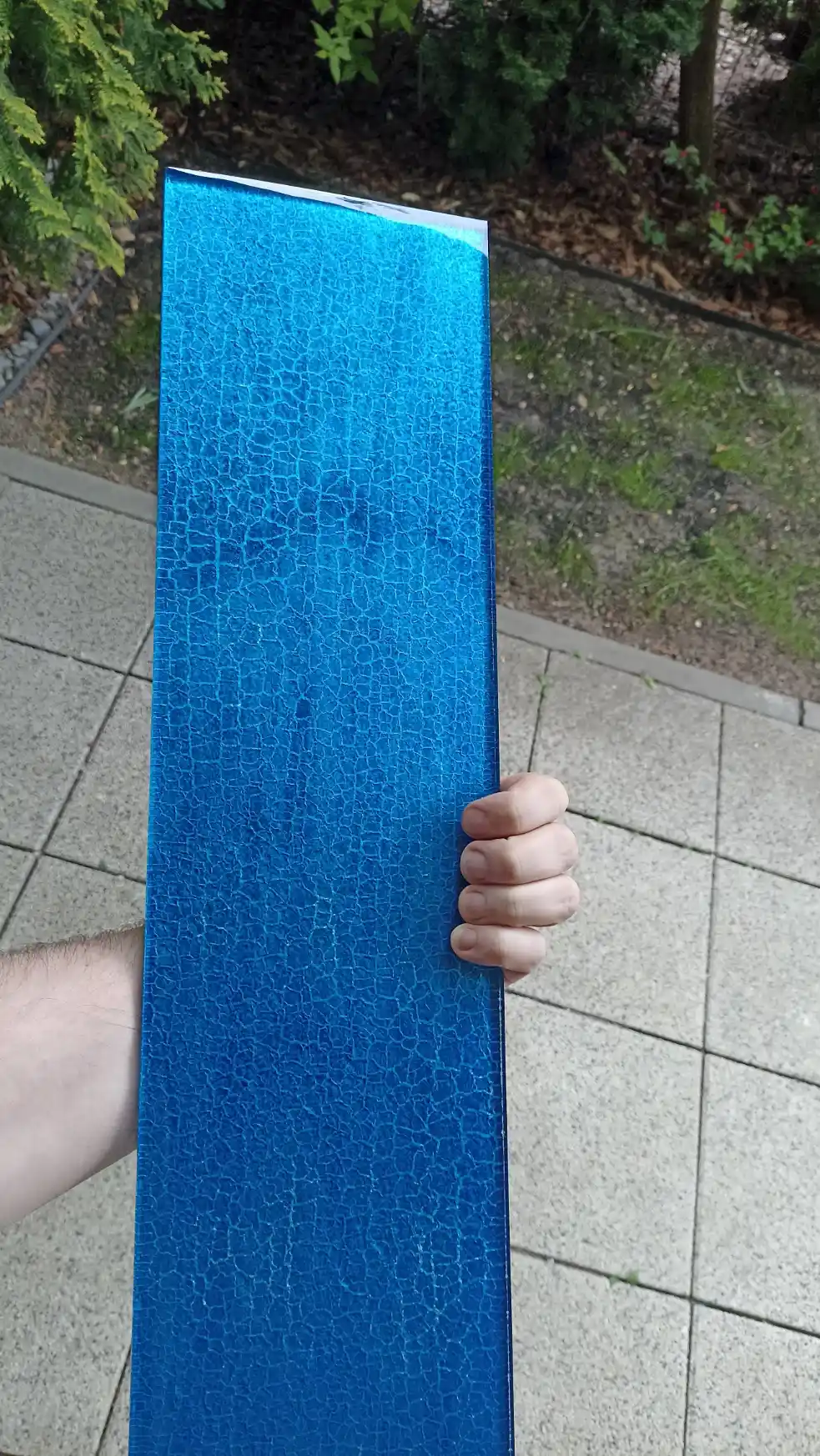
The structure you see in a finished piece — the crazing, the shading, the transitions of colour — was not drawn and not printed. It melted into being. This is not a graphic effect laid over glass, but the way the material behaved at temperature.
The whole process plays out across several temperature bands, and what comes out of the kiln depends on them:
- Around 650–680 °C — the glass softens just enough to settle into a mould. This is how curves and bowls are made.
- Around 680–730 °C — a tack fuse: the layers join but keep their own edges and texture.
- Around 790–815 °C — a full fuse. The layers run together into one smooth body.
- Each threshold gives a different look from the same set of glasses. The design decides which one, not chance.
- Annealing — a slow, controlled descent through a band of roughly 480–520 °C.
- Glass cooled too quickly keeps stress locked inside it.
- The piece then looks faultless — and cracks days or weeks later, or after its first winter.
- It is the longest part of the process: the kiln comes down over hours, not minutes.
Two things that decide whether it lasts
Fused glass on a memorial stands for decades in rain, frost and sun. Whether it survives is settled long before it is fixed — in the workshop.
Compatible glass
Every glass expands at its own rate when heated. In fusing this is described by the coefficient of expansion, and glasses fall into systems — the commonest being 90 and 96. Glasses from different systems must not be combined, even when they look perfectly joined after firing. The difference in how they contract on cooling stays in the material as stress, and sooner or later it tears the piece apart.
So a workshop buys glass within one system and does not mix it with whatever sheet comes to hand. It sounds like a detail, and it is the basic difference between a piece that lasts and one that cracks in a cemetery.
Annealing
The second matter is the descent from temperature. The kiln cannot simply cool down — it has to come through the annealing band slowly enough for the stress to disperse. Cutting this stage short speeds up production and spoils nothing immediately. The consequence arrives later, at the customer’s.
Neither of these is visible on a finished piece. A family cannot judge them and neither can a mason — you can only take the maker’s word, or find out years later. That is the real reason why, with memorial glass, it matters who made it.
Two identical pieces do not exist
A consequence of melting is that two pieces from the same design never come out identical. They always differ in the detail: the pattern of the crazing, the depth of the shading, the way the colour passes from saturated to pale.
In serial production that would be a fault. On a memorial, which by definition commemorates one person, it is the opposite — it is the one part of the stone that nobody else has in quite that form. It is worth saying so to a family plainly, because sometimes that single thing decides the choice.
What it gives a memorial
Colour the stone does not have. Granite comes in a narrow range of greys, blacks and muted browns. A saturated red, a deep blue or a green are simply not available in it. Glass brings them without disturbing the gravity of the whole, because it works in one spot: a single element on a large dark slab is enough to change how the memorial reads.
The way it behaves in light. A fused surface is not flat like a windowpane — it has a microstructure that scatters light instead of reflecting it like a mirror. The piece does not glare; it lights up from within, and its intensity shifts through the day. In a cemetery, where almost everything is matt and still, that movement draws the eye.
Colour that does not come off. The colour is not a coating laid on top, to be washed off by rain and burnt out by sun — it is in the material. A piece exposed for years to rain, frost and sunlight keeps its colour, provided it was properly joined to the stone with a flexible joint that absorbs the different movement of the two materials.
Where the colour comes from
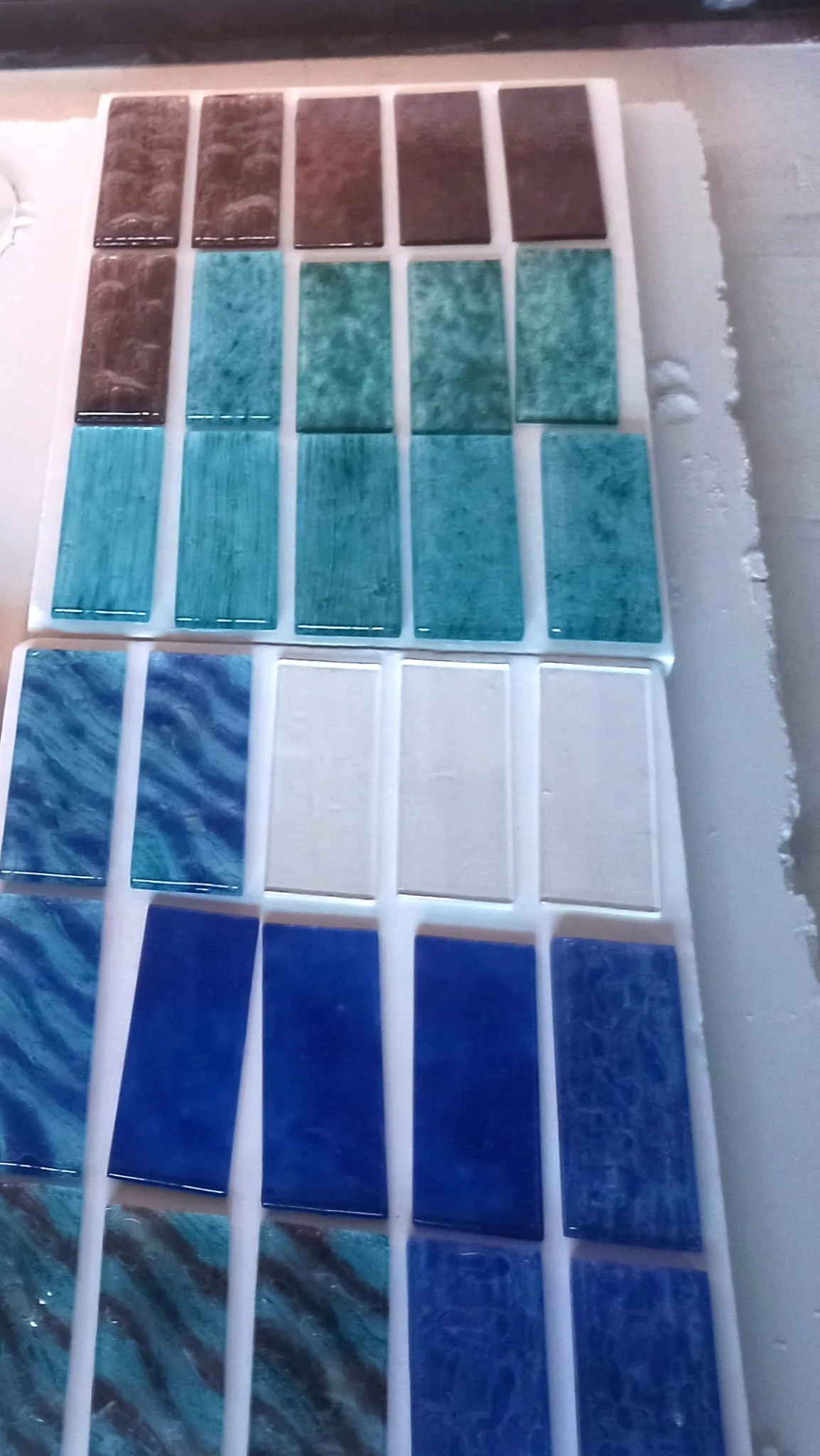
Colour in fused glass is not picked from a palette on a screen. A workshop works with the particular glasses it holds, and those set the range — hence the samplers, which show what a given colour really looks like after firing.
The difference between a sample in the hand and a photograph in a catalogue is greater than it seems. On a screen, turquoise and blue are two shades side by side. In glass, held to the light, they are two entirely different materials: one passes light and glows, the other holds it and thickens.
Memorial masons who work with glass regularly order a sampler of their own from us — it sits where the family sit down, and it closes the conversation about colour in a minute. There is more on building such a set in adding glass to a memorial mason’s offer.
Not only crosses
The same technology covers a far wider range of forms than the cross alone:
- Asymmetrical crosses — sized to the slab, set into a milled channel. The commonest choice on contemporary dark memorials with no carved cross.
- Glass hearts — either bonded to the face of the slab, or thicker and double-sided, set into the stone. Frequent on children’s graves and at anniversaries, when the memorial is already standing.
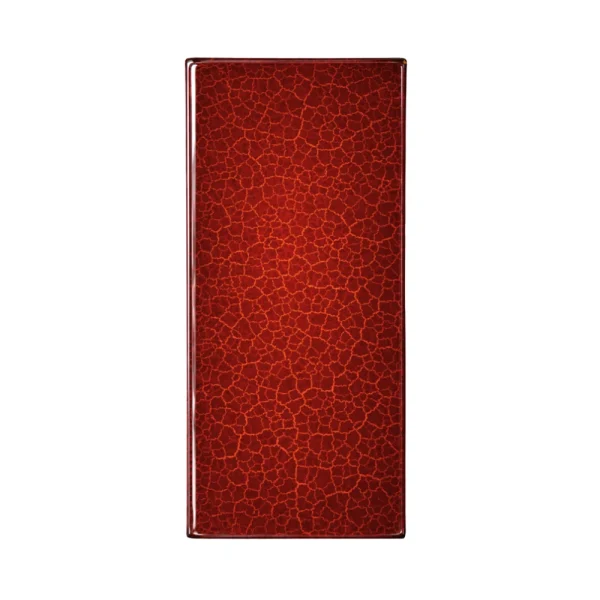
- Decorative strips — an upright accent along the edge of a slab, in several heights. They divide the face well on double memorials.
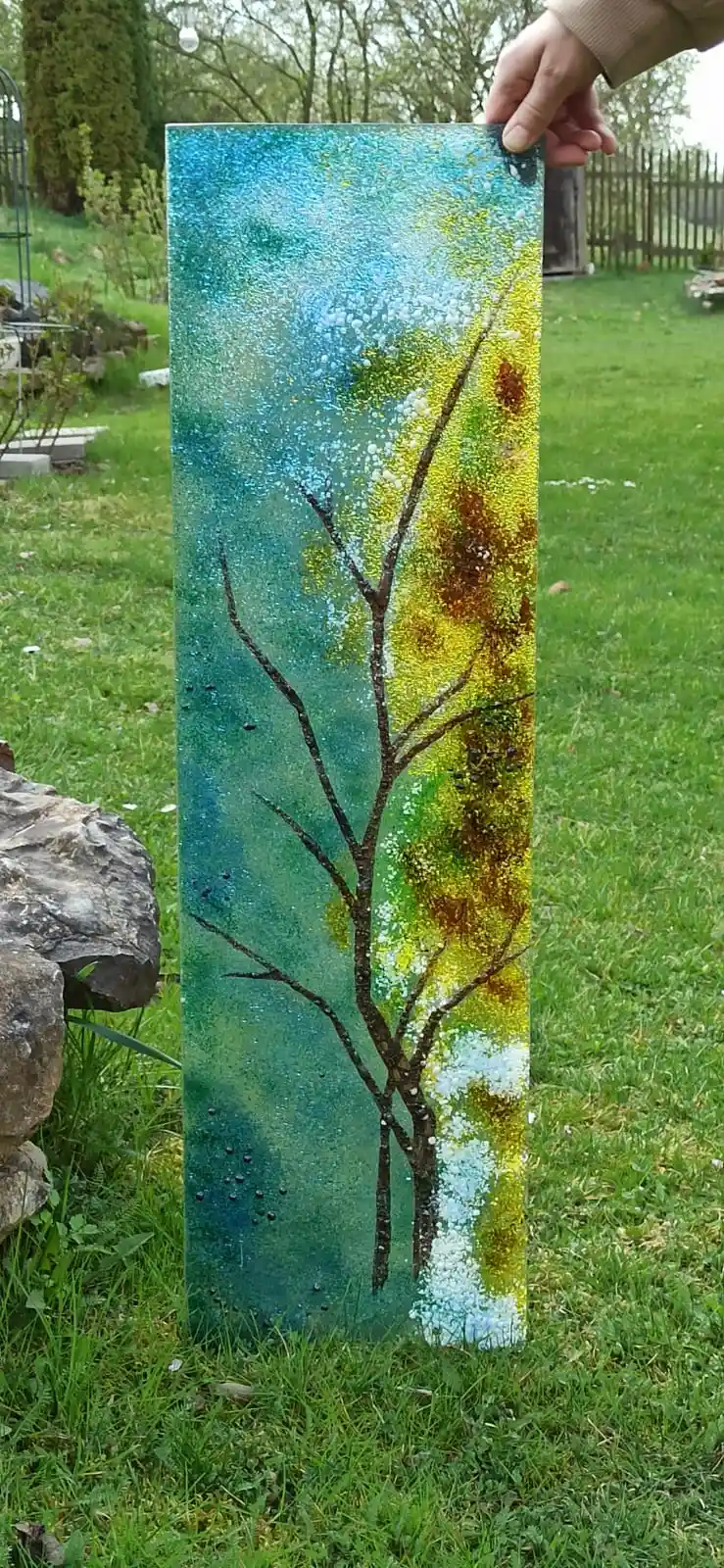
- Made-to-order fused tablets — a tree, a branch, a plant motif. Not the same as panels printed on tempered glass: here the pattern comes from glasses laid up and fired, so it has texture and depth rather than drawing.
- Lamps and plinth pieces — the same glasses, a smaller format.
Since every piece is made singly in any case, making an unusual shape is not a departure from the process — it is its normal working mode. The dimensions of the slab, or a drawing, are enough.
How it reaches the memorial
Two routes, depending on the thickness of the piece:
- The thinner, single-sided version — bonded to the face of the slab. It is backed with colour, so the stone does not show through. Fixing means degreasing and a flexible adhesive; sometimes a shallow recess, if the piece is to sit flush.
- The thicker, double-sided one — set into the stone: into a milled channel or a plinth. The design reads from both sides, but the seat has to be made along with the slab.
The rule that admits no exceptions: the joint has to stay flexible. Glass and granite expand at different rates and the joint has to absorb the difference. Epoxies and cement mortars crack, or tear the glass, in the first winter.
A technique older than glassblowing
Melting glass in a kiln predates the glassmaking we know today. The first objects made by fusing pieces of glass at high temperature come from Mesopotamia and Egypt some four thousand years ago — beads, amulets, small tiles. The Romans developed the technique into vessels assembled from coloured rods, known as millefiori.
Then, for close to two thousand years, glassblowing displaced it. It returned only in the twentieth century: first as workshop experiment, after the war as part of the studio glass movement, and from the nineteen-seventies and eighties as a field of its own with its own kilns and craft.
For a memorial this has one practical consequence. It is not a novelty whose durability nobody has tested yet — it is one of the oldest known ways of working glass, only lately used in this particular place.
Frequently asked questions
Will glass on a memorial crack in winter?
No, provided it was properly annealed in the kiln and fixed on a flexible joint. Almost all the damage we have seen came from rigid fixing or from a shortened anneal — not from frost as such.
Will the colour fade?
No. The colour is in the body of the glass, not on its surface. There is no coating to wash off or burn out.
How does it differ from stained glass?
Classic stained glass is pieces of glass joined with lead or copper tape. Fusing has no joints — the layers are melted into one body, so there is nothing to work loose.
And from printed glass?
With printing, an image is applied to a sheet. With fusing there is no image to apply — there is an arrangement of glasses that creates the pattern during firing. Both are durable, but the effect is quite different: printing renders detail, fusing gives depth and texture.
Can we order a shape that is not in the catalogue?
Yes, and that is the normal way of working. The dimensions of the slab or a drawing are enough; we match the proportions and prepare a design to approve.
How long does it take?
Usually about 3–6 weeks, with a design to approve within two or three days.
Can the colour be matched to a particular granite?
Yes — that is what the sampler is for. Colour is judged at the stone and against the light, because the same glass looks different there than in a photograph.
In short
- Fusing melts layers of glass in a kiln — the colour and texture arise in the firing; they are not print.
- The temperature threshold decides the look: a tack fuse keeps edges, a full fuse runs them together.
- Durability rests on two invisible things: compatible glass and a slow anneal.
- Two identical pieces do not exist — on a memorial that is an advantage.
- The colour is in the body, so it does not fade or come off.
- Fixing: the thinner version on the face, the thicker one into the stone, always on a flexible joint.
- Colour is chosen from a sampler at the stone, not from a photograph.
Our pieces in fused glass
The three groups we make with this technique — each tile opens the category:
 Glass hearts
 Decorative strips
For a shape outside the catalogue, the dimensions of the slab or a drawing are enough — we match the proportions and prepare a design to approve.
+48 789 024 384biuro@deseomemorials.com