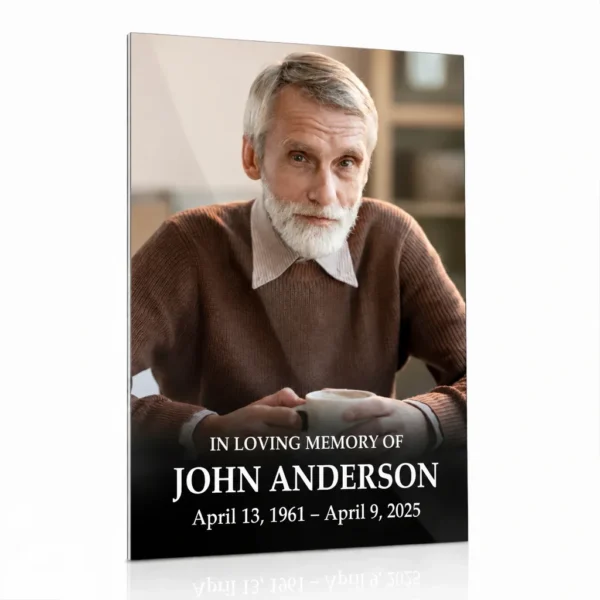
The family brings a poor photograph. How to solve it in a day
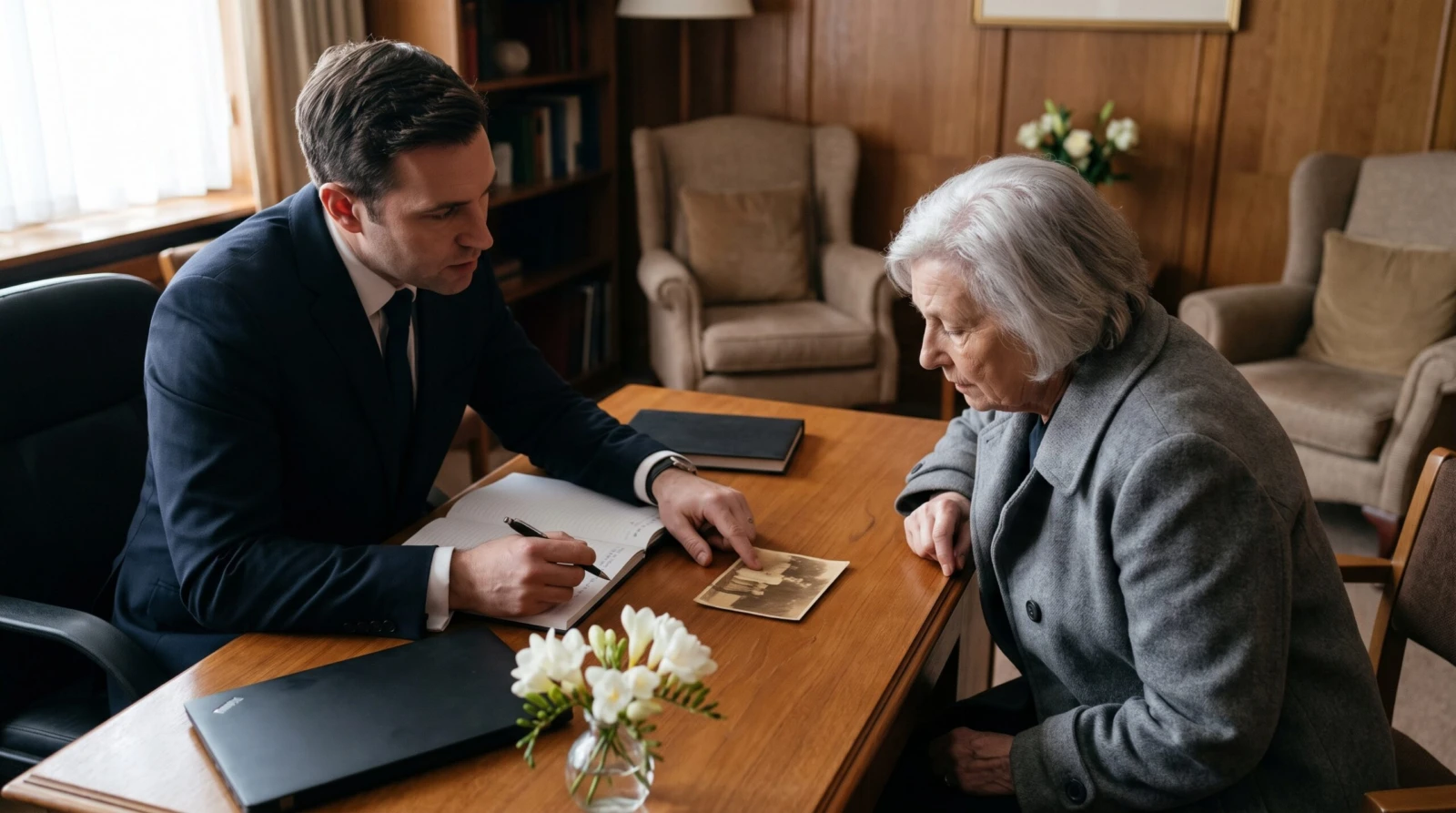
A finished path for funeral directors and memorial masons: from a creased print on the desk to a framed portrait at the service, with no designer on the premises.
Express within 24 hours
Orders placed before 12:00 come back within a day. On the firm’s details, the file by email.
Order a restoration
Every funeral director knows the moment: the family sits down, takes a creased print out of a wallet or turns a phone screen round and says “it’s the only photograph we have”. The order of service goes to print tomorrow. There is no designer on the premises and there never will be, and sending the family away with nothing is the worst of all the options.
This is an operating procedure, not a guide for families. It sets out a finished path: how to take a poor photograph in within two minutes, where to send it for restoration, what to do with the returned file the same day, and how to use the same file again when the memorial is ordered — without anyone in your office touching image-editing software.
The path in brief
Four steps. With an order placed before noon, the framed portrait is with the family the next day:
Photograph the print by a window, or ask for the original file from the phone. Note three things: the print size wanted, colour or black and white, and the background.
The form on the service page, ordered on the firm’s details with a VAT number. In the notes, say if the photograph may later go on a memorial as well.
It comes cropped to the size you gave and ready to print. Save it in the file for that funeral — our own copy is deleted after seven days.
Matte paper at your usual photo shop or in house, a plain frame, a black ribbon. The portrait leaves for the service.
Step 1. Taking the photograph in
More quality is lost here, in the first two minutes, than anywhere else in the process. Three rules worth pinning above the desk:
- Never through a messaging app. Apps shrink photographs as they send them. Ask for the file by email, or copy it straight off the family’s phone.
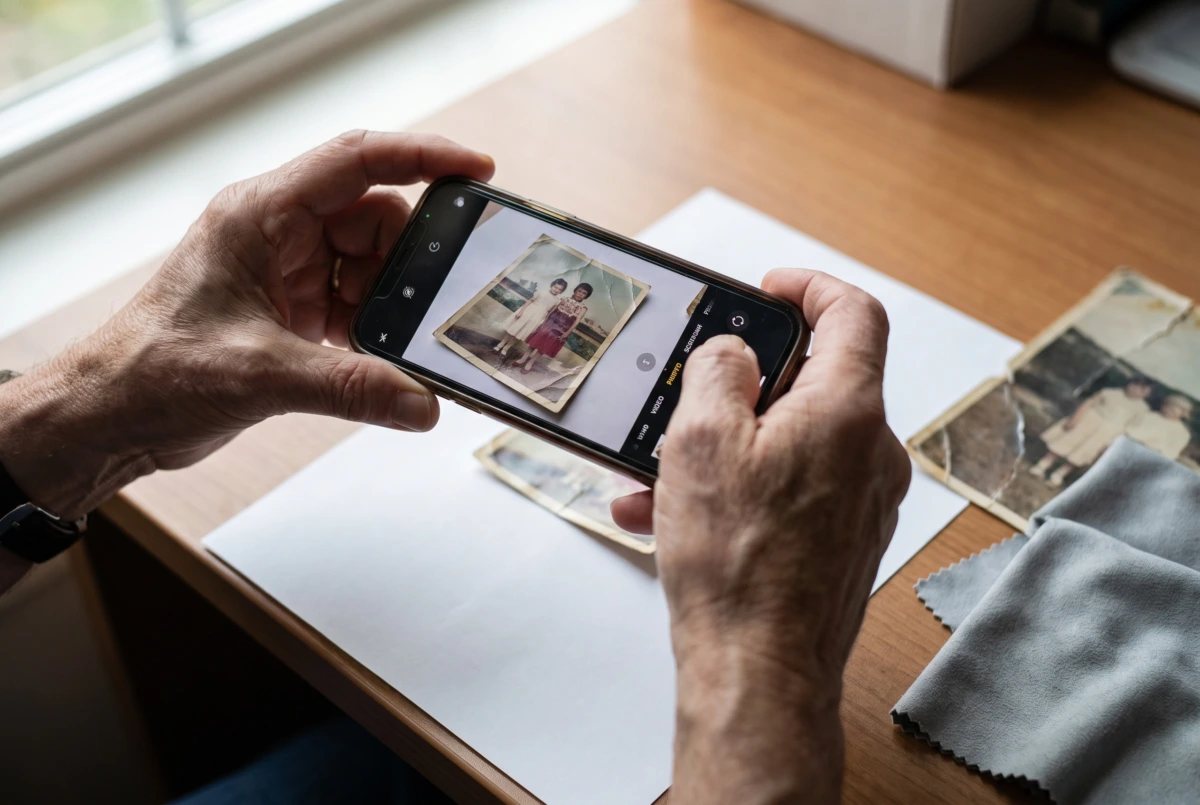
- Photograph a print rather than rushing it through a scanner. Lay it flat on a sheet of white paper by a window, hold the phone parallel to it, no flash and no shadow of your own falling across it. A frame taken that way beats a quick scan on an office multifunction.
- Take several pictures, not one. With three candidates the chance that one has open eyes and a face turned forwards goes up several times over.
The thirty-second test. Zoom in on the face until it fills the phone screen. If the shape of the eyes, the nose and the mouth is still there, you have something to work with. If the face falls apart into patches, say so straight away and ask for another photograph rather than promising a miracle.
Before the family leaves, note down: the print size (usually 20×30 or 30×40 cm), colour or black and white, the background (plain or unchanged) and whether the photograph may later go on a memorial. Those four answers are enough to place the order without ringing back.
Step 2. Ordering the restoration
You order on the photo restoration page. The whole thing is digital — you upload the file online and receive a link by email, with nothing posted in either direction.
- Express within 24 hours — €39,00. Orders placed before 12:00 Polish time come back within a day; anything later moves to the next working day. This is the option when the service is this week.
- Delivery within 72 hours — €21,00. Enough when the funeral is a week or more away, or when the job is a memorial photograph.
The form takes JPG, PNG, WEBP and TIFF files up to 64 MB. You choose the turnaround, the print size and the background — eleven tones to pick from, or the background left as it is. The order goes on the firm’s details with a VAT number, so it lands on your invoice.
One thing worth putting in the notes: if there is any chance the same photograph will end up on a memorial, say so. We will then prepare the file for the largest format rather than only for the portrait at the service — it does not work the other way round, and six months later the restoration would have to be ordered again.
Files for large formats can also come straight to img@deseomemorials.com.
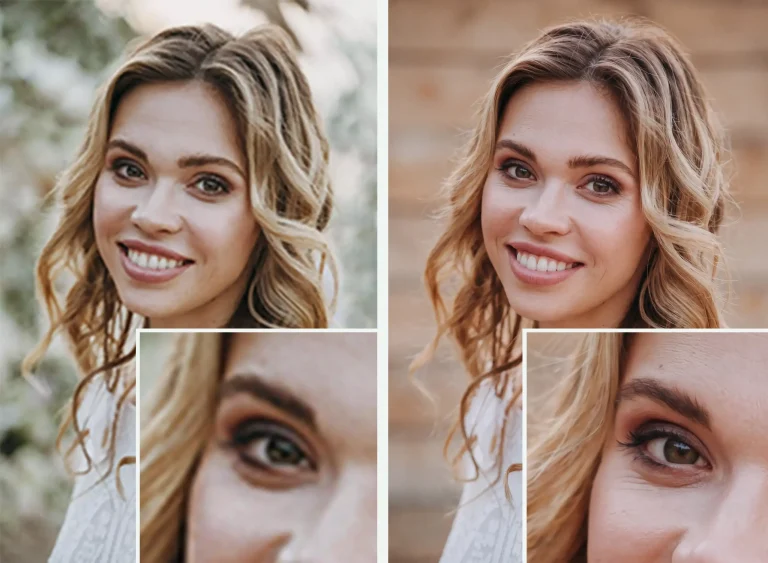
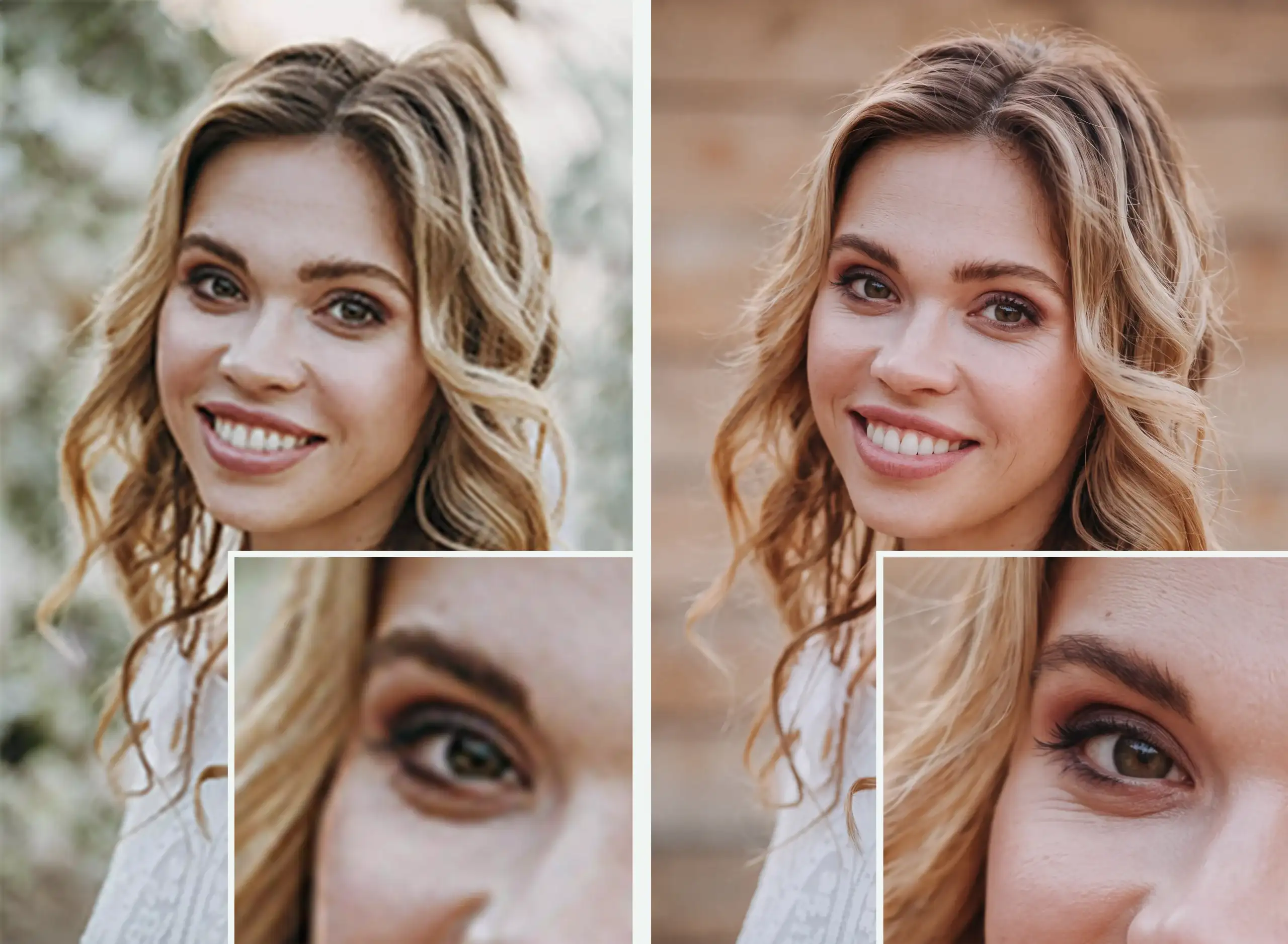
Original on the left, restored file on the right
Photo restoration
for headstones and funeral ceremonies
The service is for funeral homes, stonemasons and private individuals who need a photograph improved quickly — in time to have it printed by a local photographer for the ceremony, or prepared for use on a headstone.
We also restore photographs in very poor condition — we remove paper texture, grain and yellowing, bring back sharpness in the face and hair, and crop the frame to the format you choose. We hand over the print-ready file as a link you download to your computer.
Step 3. Printing and framing
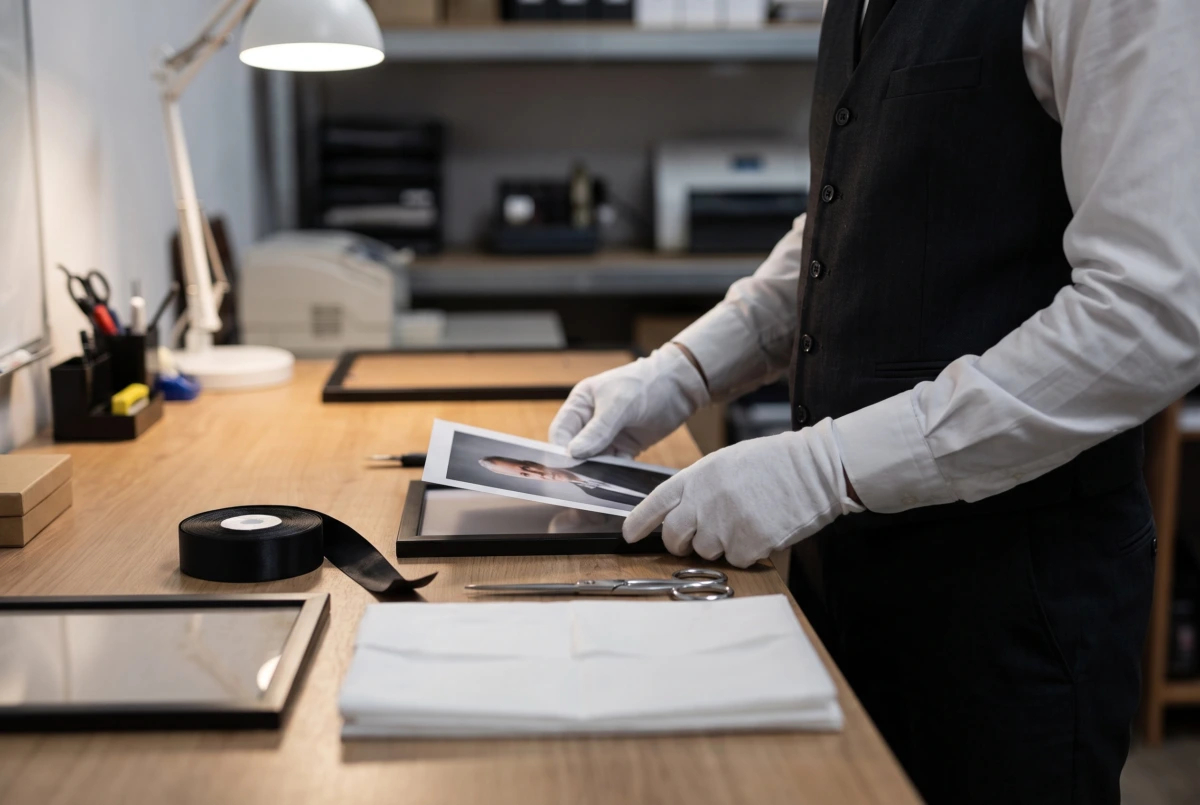
The finished file is already cropped to the size you gave, so there is nothing left to agree at the photo shop. What to watch:
- Matte paper. The portrait stands among candles and lights; the sheen of glossy paper spoils the pictures the family takes during the service.
- A plain black frame. Slim or wider — both look right, as long as it is not ornate.
- A ribbon that lifts off. Fix the black ribbon so it can be removed afterwards. The portrait stays with the family for years; the ribbon belongs to one day.
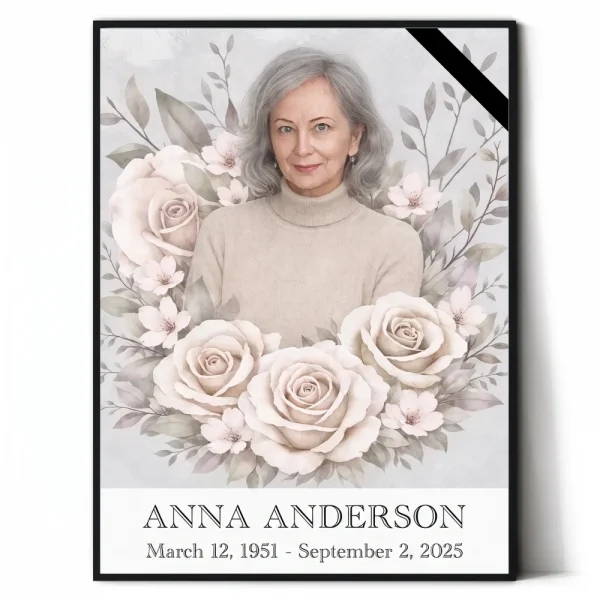
If you would rather not print in house, the same file can come back to you as a finished framed portrait from our workshop — the design is ready within 24 hours, printing and framing take 2–3 working days plus delivery. With a week before the service that fits comfortably; with two days, printing locally is faster. The range is in memorial pictures.
Step 4. The same photograph on the memorial
Here the path divides between funeral directors and memorial masons, but the file is the same one. A family that comes back for the memorial six months later has nothing to search for, as long as you kept the file with the paperwork.
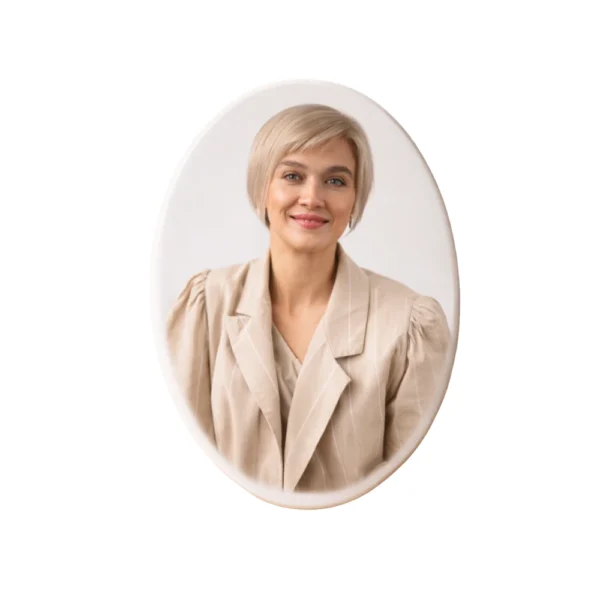
- Porcelain — the classic oval or rectangle, 4×6 to 18×24 cm, fitted with a flexible adhesive and no work to the stone.
- Crystal — thick glass with polished edges, 8×10 to 18×24 cm, fitted on mounting tape without drilling.
- A large tempered-glass panel — 20×30 to 60×90 cm, in 8 or 20 mm. Agree the size, the thickness and the fixing before ordering.
The portrait design comes back for approval within two to three days, so you can show it to the family before production, and the whole order usually takes three to six weeks. One point specific to the UK: check the burial ground’s rules before promising a size — many churchyards do not allow photographic plaques at all, and cemeteries often set a maximum. The large format has its own guide: large photo for a headstone, and the way one file covers everything is in one photograph, many uses.
What to say to the family
The conversation about a poor photograph is often harder than the job itself, because families frequently feel guilty that nobody ever had a proper picture taken. A few lines that work in practice:
- Instead of “this photograph is no good” — “a portrait can be made from this; we need a day for it”.
- Instead of “we’ll try to do something with it” — “the restoration costs this much and will be ready tomorrow; we will show you the result before anything is printed”.
- When the picture really is weak — “have a look through the grandchildren’s phones and any documents; if nothing turns up we will work with what we have, and I will tell you honestly what will come of it”.
Do not go into the technology. The family is not asking how it is done — they are asking whether it will be ready for Thursday and whether it will look dignified. Both answers are a date and a price, not a description of a process.
What not to promise
Drawing the line honestly at the counter costs less than a complaint the day before the funeral. A portrait cannot be built when:
- the face is hidden behind a hand, a glass, a microphone or another person,
- the photograph was taken from a long way off and the face is a few blurred patches,
- only a profile exists and the family expects a front-facing portrait — the quality can be improved, but the head cannot be turned,
- the eyes are closed in every available frame.
In those cases send the file to img@deseomemorials.com before placing an order and we will tell you whether a portrait can be made from it. Two minutes of your time and no risk to the family. What can be rescued from genuinely difficult sources is covered in we have no good photo of the deceased.
Three cases from practice
A passport or photo-booth picture. Small, hard flat light, a date stamp in the corner and years of wear from a wallet. The commonest case with people who hated being photographed. It works — and the serious expression stays, because that is how document photographs were taken.
A face cut out of a wedding group. The face the size of a thumbnail, other people alongside, reception lighting on the skin. It works, on one condition: take the whole photograph from the family, not a crop made on a phone. The full file holds several times more detail. Say in the notes which person it is.
A frame paused on a video. Soft, lit by a ceiling light, caught mid-sentence. Harder than a print, but workable. Ask the family to save two or three different frames and we will choose the best.
What it costs the firm
The restoration is a one-off cost, whatever happens to the file afterwards: €21,00 within 72 hours and €39,00 for express delivery within 24 hours. What you charge the family is your own pricing; we invoice the service to the firm.
Beyond that there is only what you already have: the print and a frame, or a finished portrait ordered from us. There is no charge for the design, for adjusting the crop, or for a second crop from the same file — if the order of service needs a tighter frame than the portrait at the service, we prepare both.
If this happens weekly, the terms of a standing arrangement are on our cooperation page.
Frequently asked questions
Do we need a designer or editing software?
No. All the editing is at our end; yours is taking the photograph in, placing the order and printing.
Will it be ready if the service is the day after tomorrow?
Yes, on the express option. An order placed before 12:00 comes back within a day; printing then takes a few hours.
Can we order on the firm’s account?
Yes. Order on the firm’s name and VAT number, and we email the link to the company address.
What if the family is unhappy with the result?
You show them the file before printing — that is the moment for comments. Small adjustments to the crop are made at no extra charge.
Can we order a framed portrait instead of a file?
Yes. The design is ready within 24 hours and printing with framing takes 2–3 working days plus delivery — the option when there is a week before the service.
How long do you keep the file?
Our copy is deleted seven days after delivery, so save it with the paperwork. It will be wanted again when the memorial is ordered.
Do you make sizes outside the list?
Yes, for memorial photographs. Give us the height and the width and we will price it.
The crib sheet
- Photograph the print flat, by a window, no flash — or take the original file, never through a messaging app.
- Take several pictures and run the thirty-second test.
- Note: print size, colour or black and white, background, and whether it may go on a memorial.
- Order the express restoration before 12:00, on the firm’s details.
- Collect the file the next day, save it with the paperwork and show it to the family.
- Print on matte paper, frame it, add a ribbon that lifts off.
- After the funeral, offer the same portrait for the memorial.
Recommended products
Everything below can be ordered from the same file, prepared once:
We will set out the terms of a standing arrangement, advise on an unusual job and price a memorial photograph in a size outside the list.
+48 789 024 384biuro@deseomemorials.com
Porcelain photos
Crystal photos
Large memorial photos
Memorial pictures