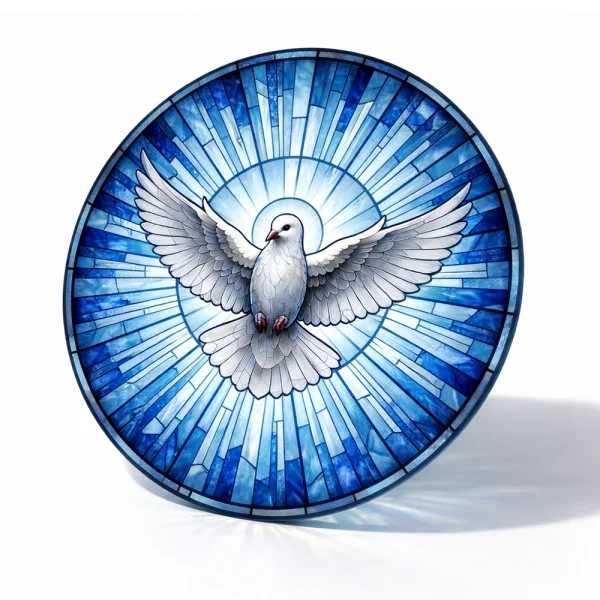
Adding glass to a memorial mason’s offer — where to start
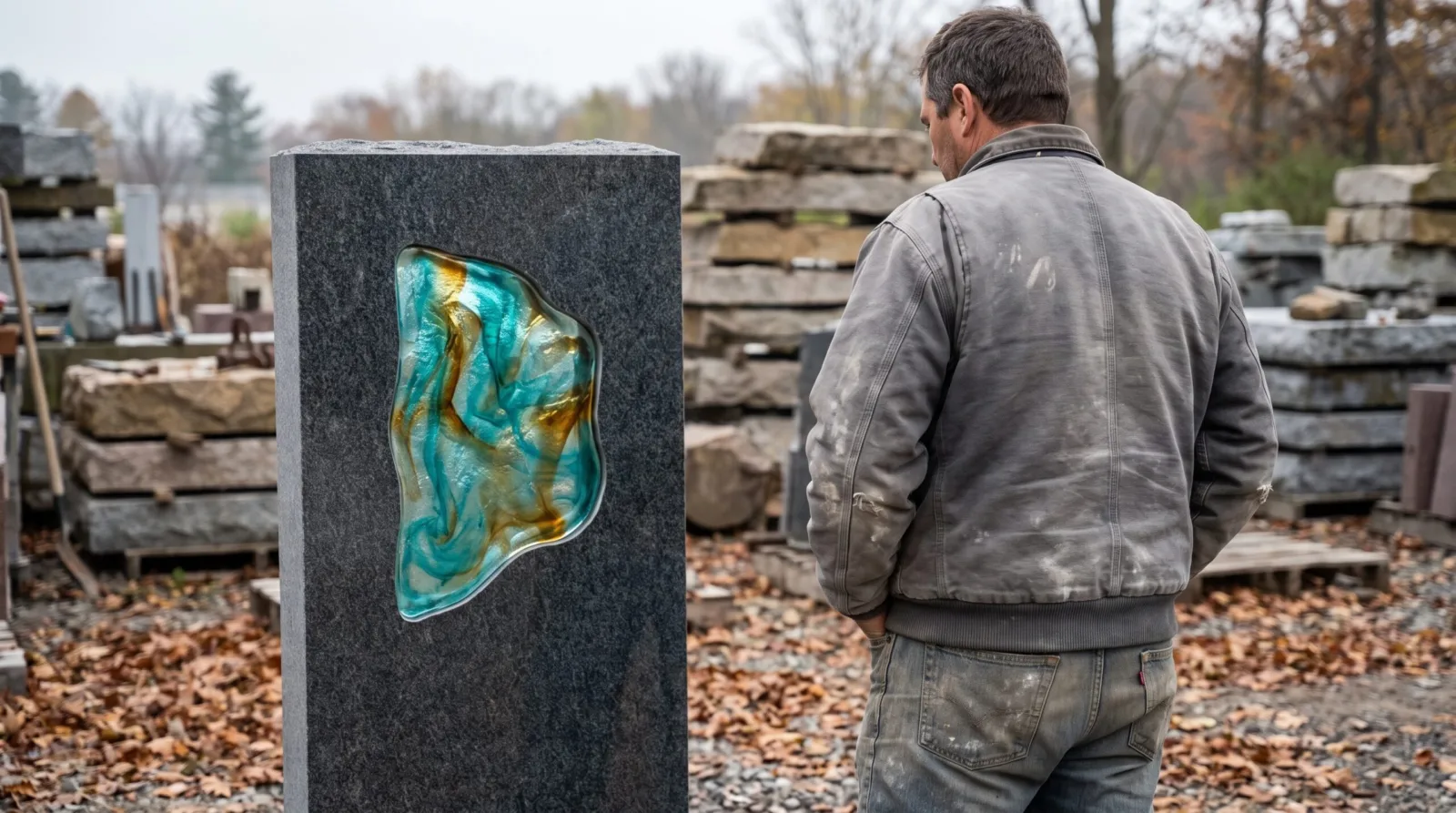
Coloured fused glass decoration set into the face of a granite memorial
For masons
Adding glass to a memorial mason’s offer: where to start

No machine, no stock and no selling. Five groups of products, seven rules for sizing and one way of fixing.

Published 14 November 202612 min read
Contents

Most memorial masons sell granite well and glass not at all. Not because families do not want it, but because nobody showed it to them and nobody could answer the three questions that follow straight away: what does it cost, what size should it be, and how does it stay on the stone.

Glass is the cheapest way a memorial workshop can widen its offer. No machine, no unit, no stock on a shelf. What it does take is knowing which groups actually sell, how to size them and what to fix them with. That is what this is. How to show glass across the desk is a separate piece — the catalogue and the demonstration set.

Why glass

From the workshop’s point of view this is the extension that changes nothing in the yard:

  • No stock. Every piece is made to order, in about 3–6 weeks, with a design to approve within two or three days. Nothing is tied up on a shelf.
  • No new machinery. All the work at your end is a milled channel, or a degreased slab and a line of adhesive.
  • A bigger order without a bigger slab. Glass decoration runs from roughly three hundred to eleven hundred euro on the same memorial you were building anyway.
  • One question at the desk. Nothing has to be sold: it is enough to ask whether the family want colour on the memorial.

Prices below are retail, in euro, as the shop shows them. A workshop logged in to a trade account sees its own price in the same places, and the difference stays with the workshop.

Two kinds of glass, two different conversations

Everything below belongs to one of two families. They differ not in price but in what they are and how they are fixed — and the family at the desk is choosing between them whether or not anyone names it:

Fused glassColour inside the body
  • Melted by hand in a kiln; the colour is inside the glass, not on its surface.
  • Two thicknesses: single-sided, 1 cm, to be glued on and double-sided (laminated), 2 cm, to be set in.
  • The single-sided version is backed with colour, so the stone does not show through once it is fixed.
  • This is where hearts, asymmetrical crosses and decorative strips belong.
  • Character: a solid, sculptural piece; light breaking in the edges. No image, no photograph.
Tempered glassAn image fired in a kiln
  • Two sheets of ultra-white tempered glass with a ceramic print fired in a kiln between them — the pigment fuses into the structure of the glass.
  • Thicknesses: 8 mm (4+4), 10 mm (5+5), 20 mm (10+10).
  • Available light-transmitting (for a plinth, where daylight can reach it) or backed (for the face of the slab).
  • This is where stained-glass panels, motif panels and large photographs belong.
  • Resistant to weather, damp, temperature swings and UV.

Five groups worth starting with

You do not need the whole catalogue. These five account for most orders and cover almost any conversation that can happen at the desk:

Fused glassGlass hearts
Sizes
15 × 13, 20 × 17.5, 25 × 22 and 30 × 26.5 cm; a separate crushed-glass version is 3 cm thick
Versions
single-sided 1 cm to glue on, or double-sided 2 cm to set in
Price
from €275
When to offer
when a family say the memorial looks too bare; on children’s graves; at anniversaries, when the memorial is already up and something has to be added
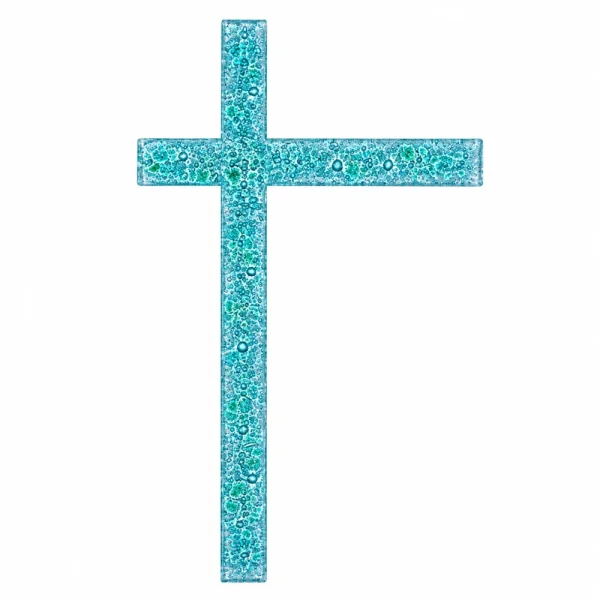
Fused glassAsymmetrical crosses
Sizes
matched to the slab: a 56 × 66 cm cross for a 60 × 70 cm slab, 56 × 71 for 60 × 75, 56 × 76 for 60 × 80, 56 × 81 for 60 × 85
Fixing
set into a channel milled in the main slab
Price
€738 – €896
When to offer
on a contemporary dark memorial with no carved cross — a glass cross is the one element that brings colour without arguing with a plain form
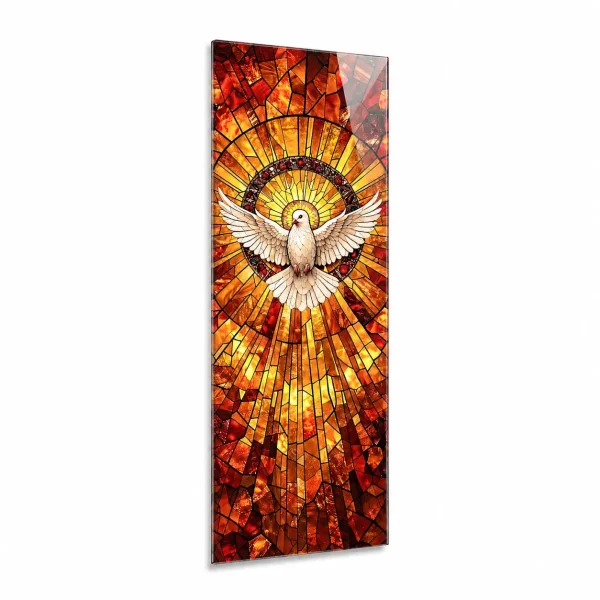
Tempered glassStained-glass and motif panels
Sizes
upright from 16 × 45 to 30 × 85 cm (one design to 35 × 110), horizontal from 45 × 13 to 75 × 23 cm, square 20 × 20 – 35 × 35 cm, round 28, 30 and 35 cm
Thickness
8, 10 or 20 mm, light-transmitting or backed
Price
from €286
When to offer
on traditional memorials and on narrow slabs where nothing else will fit; the light-transmitting version whenever it can be set into a plinth
Tempered glassLarge photographs on glass
Sizes
20 × 30, 30 × 40, 40 × 50, 50 × 70 and 60 × 90 cm
Thickness
8 or 20 mm
Price
€278 – €1 094
When to offer
when the family have a good photograph and want a portrait rather than a small oval; it is the one item you can price yourself in seconds, with the calculator
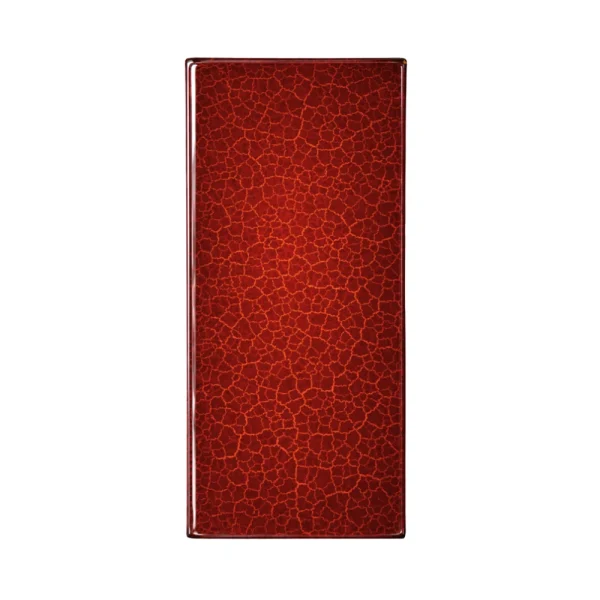
Fused glassDecorative glass strips
Sizes
from 15 × 55 to 15 × 100 cm in 5 cm steps — ten heights in three colours
Versions
single-sided 1 cm to glue on, or double-sided 2 cm to set in
Price
€328 – €1 075
When to offer
as an upright accent along the edge of a slab, instead of a narrow panel; it works well on double memorials, where it divides the face in two
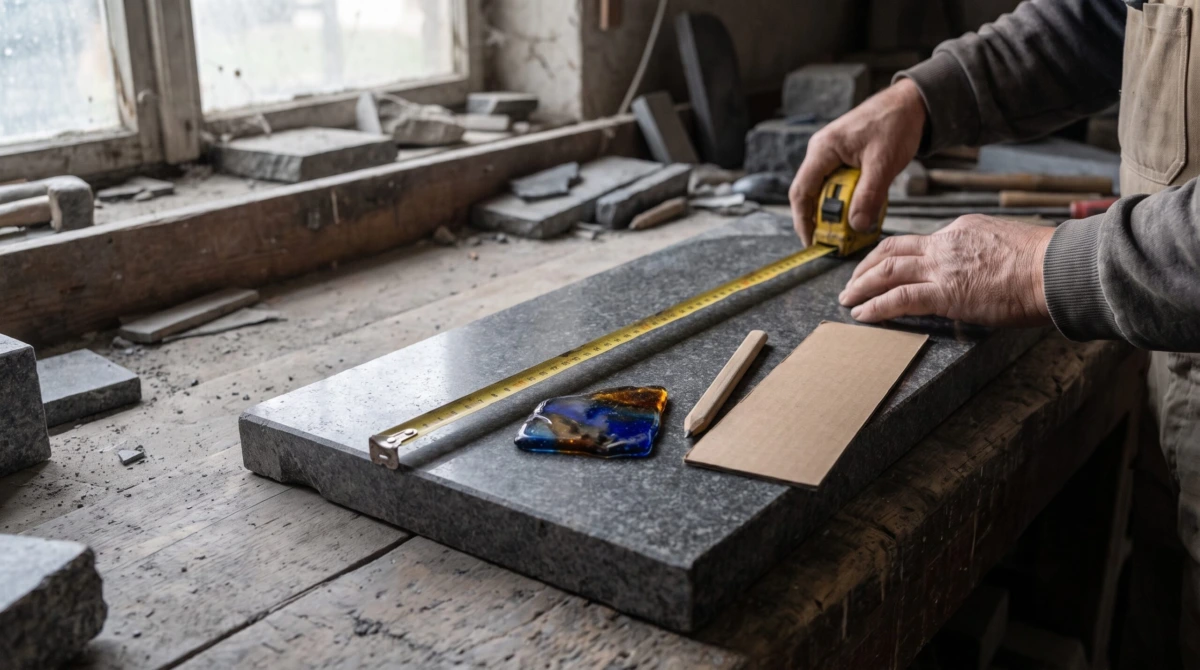
Stonemason measuring a granite slab with a tape to size a glass decoration
The size is settled at the stone — with a tape and a cardboard template, not on a phone screen.

How to get the size right

The commonest complaint in this trade is not about the glass but about the size: the family chose on a phone and ordered one size too small. Seven rules that close it:

  1. A cross is taken from the slab, not judged by eye. The size grid is built for slabs from 60 × 70 to 60 × 85 cm and keeps a constant margin. On a wider slab a cross starts to look lost — there, a panel is the better answer.
  2. An upright panel: about two thirds of the height of the field and a third of its width. The size grid (16 × 45, 18 × 50, 20 × 55, 22 × 60…) holds that ratio for you; you only pick the height.
  3. A large photograph is measured by the face, not by the slab. 30 × 40 cm reads well from two or three metres. 50 × 70 cm is a portrait that takes over the whole memorial — and that is the family’s decision, not yours.
  4. A strip reaches the field it stands beside, not the whole slab. On a 100 cm slab a 15 × 80 cm strip sits well; full height looks structural.
  5. A 15 × 13 cm heart is an accent; 30 × 26.5 cm is the main motif. There is nothing in between — decide which one it is on this memorial.
  6. Thickness follows the fixing, not the price. 8 mm and the single-sided 1 cm go on the face of the slab. 20 mm and the double-sided 2 cm go into a plinth or a channel. The other way round does not work.
  7. Always a cardboard template against the stone. Thirty seconds of work, and the size question is closed for good. The order of that conversation is in talking to families about the photograph and the decoration.

One thing to check before anything else in a churchyard. In most Church of England churchyards the diocesan regulations set out what materials and colours are allowed, and coloured glass usually falls outside the list the incumbent can approve on their own — it needs a faculty. Local-authority cemeteries set their own rules and are generally more relaxed, but they still have them. Ask at the office before you show a family anything.

A calculator, so nobody has to add up

Large photographs have the most combinations: five sizes, two thicknesses, fixing holes. Instead of hunting through a price list, use the large photograph calculator — pick the size, the thickness and the number of holes, and the price is there.

Two things worth knowing: a workshop logged in as a partner sees its own price alongside the retail one. And it works at the desk — the calculator opens on a phone, so the family get an answer about price in the same conversation in which they asked.

A headstone photograph before and after restoration Original on the left, restored file on the right

Photo restoration
for headstones and funeral ceremonies

The service is for funeral homes, stonemasons and private individuals who need a photograph improved quickly — in time to have it printed by a local photographer for the ceremony, or prepared for use on a headstone.

We also restore photographs in very poor condition — we remove paper texture, grain and yellowing, bring back sharpness in the face and hair, and crop the frame to the format you choose. We hand over the print-ready file as a link you download to your computer.
Drag your photo hereJPG, PNG, WEBP, TIFF — up to 64 MB Choose file
€21,00
standard, within 72 hours
€39,00
express, within 24 hours
Go to the service

Fixing: an elastic joint, never a rigid one

Glass and granite move differently. With every change of temperature each expands by a different amount, and the joint has to absorb the difference. Hence one rule: the adhesive must stay flexible for good. Epoxies, cement mortars and anything that sets hard will crack the joint — or the glass — in the first winter.

What to use

A neutral-cure mirror silicone is the right material; in Poland the one reached for is LAKMA mirror adhesive, and any neutral-cure mirror silicone with the same figures will do:

  • solvent-free, colourless, neutral cure — it does not discolour the backing and does not attack coatings;
  • adheres to glass, glass laminates, concrete, cement mortars, brick and metals;
  • temperature resistance −40 to +180 °C;
  • application temperature +5 to +35 °C — not in frost, and not on a slab standing in full sun;
  • working time about 10 minutes — once the beads are down, the glass goes on straight away.

How to fix it

  1. Degrease both surfaces. Granite and glass, dry, with no polishing residue left. Skipping this accounts for most of the pieces that come away.
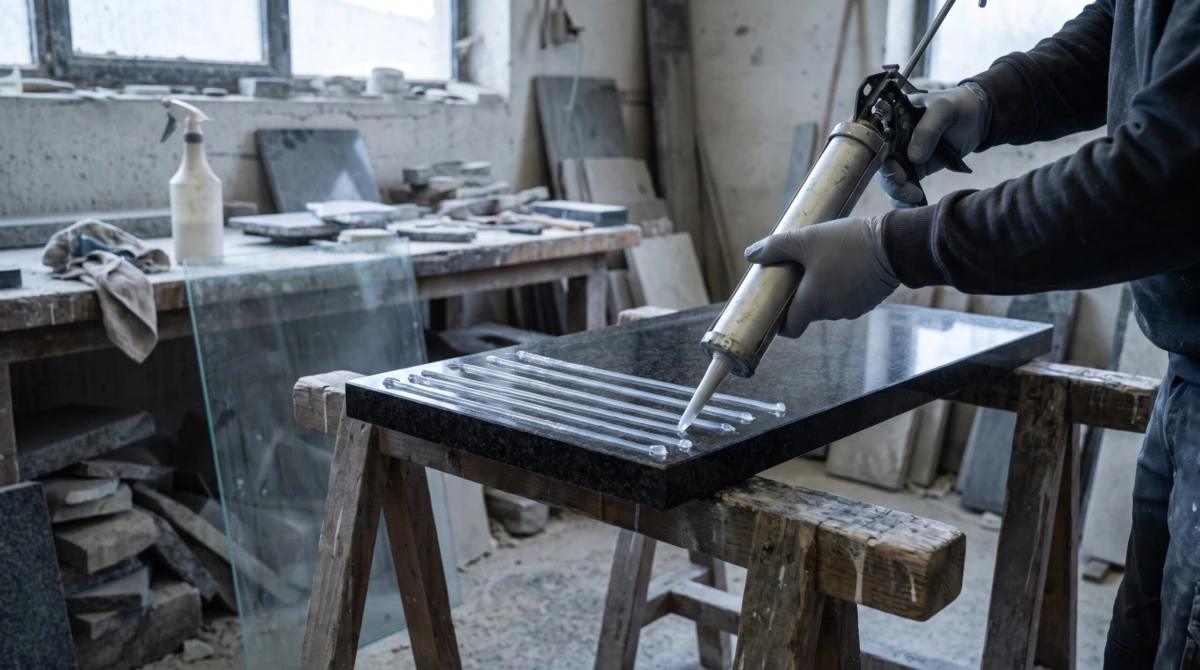
  2. The beads go on the stone, not on the face of the glass. Parallel, upright, roughly every 10 cm.
  3. Bead diameter about 40 % greater than the intended gap. For a 5 mm gap that is an 8 mm bead — pressed home, it spreads to the right width and does not squeeze past the edge.
  4. Support it until it has cured. Glass and polished granite take up no moisture, so silicone cures more slowly than on masonry — mounting tape to hold the piece while it cures is the simplest answer. Full cure is counted in days, not hours.

The test not to skip

The manufacturer lists glass, concrete and cement mortars among the substrates — natural stone is not on that list. Polished granite is non-absorbent and the risk is small, but a memorial is not the place to find out. A day earlier, run a bead on an offcut from the same batch of stone and see whether a halo appears.

What not to do

  • Do not bed it in mortar. The double-sided 2 cm versions go into a milled channel or a plinth and are sealed with a flexible material — never with cement.
  • Do not drill glass on site. Fixing holes are made before tempering; a drill in a cemetery ends in a cracked sheet.
  • Do not use expanding foam. It expands and pushes the glass out of the joint.
  • Do not fix in the rain or onto a wet slab. Below +5 °C the joint will not cure as it should.
Parallel beads of elastic adhesive on a granite slab before a glass panel is fixed
The beads go on the stone, parallel, roughly every 10 cm — never on the face of the glass.

Where to start this week

Five steps that fit around everything else:

Day 1Open a trade account

Registering gives you prices once you are logged in and the catalogue as a PDF. Without it you do not know your margin, and without that figure there is nothing to put to a family.

Day 1Pick three items, not thirty

One heart, one cross, one light-transmitting panel. That covers the three commonest conversations. The rest of the catalogue you will learn along the way.

Week 1Order a set of samples

A few fused-glass samples, an offcut of a light-transmitting panel and three cardboard size templates. Glass in a catalogue looks like a sticker; in the hand it looks like what it is.

Weeks 2–3Put one piece in the display yard

One finished element on your own display memorial. A family who came to look at granite will see it in passing, with no selling on your part.

Straight awayAdd one question to the conversation

“Would you like some colour on the memorial?” — asked after the stone is settled and before the lettering. That is enough for the subject to come up at all.

How working together looks

On the cooperation page you pick only the parts that interest you — there is no all-or-nothing package:

  • A trade account with discounted prices and catalogues. Prices once you are logged in, the catalogue as a PDF, and a printed one once we are working together.
  • Display pieces for your yard. A glass panel, a stained-glass panel or a large photograph on your own display memorial.
  • Customers from your area. Enquiries that reach us are passed to the partner for that region.
  • Graphic support. Print-ready files from old photographs, and advice on material and fixing.
  • A website for the firm, for businesses that do not have one yet.

We work with a small number of partners in each region, so terms are agreed individually, by phone or by email.

What goes with what

The six pieces most workshops start from — each picture opens the product:

Frequently asked questions

Do we have to hold stock?
No. Everything is made to order, in about 3–6 weeks, with a design to approve in two or three days.

What is the trade discount?
Partner prices show once you are logged in to a trade account; terms are agreed individually on the cooperation page.

What is the difference between single-sided and double-sided?
Single-sided is 1 cm thick, backed with colour, and is glued to the face of the slab. Double-sided is 2 cm, the design reads from both sides, and it is set into the stone.

What does “light-transmitting” mean?
That the panel passes daylight, which only makes sense where daylight can reach it — in a plinth, not against a stone slab. The backed version goes on the face.

Does the print fade?
No. The pigment is fired in a kiln and fused into the structure of the glass, between two tempered sheets — hence the resistance to damp, frost and UV.

What adhesive should we use?
A flexible, neutral-cure silicone — in practice a mirror adhesive. Never anything rigid: no epoxy, no cement.

Is coloured glass allowed in a churchyard?
Not automatically. Diocesan churchyard regulations usually keep coloured decoration outside what the incumbent can approve alone, so it needs a faculty; council cemeteries set their own, generally looser, rules. Ask before you show the family anything.

What if the family’s photograph is poor?
That we handle separately — details on the service page. The file comes back good enough for a 50 × 70 cm portrait.

The crib sheet

  1. Two families of glass: fused (hearts, crosses, strips — colour in the body) and tempered (panels and large photographs — an image fired between two sheets).
  2. 1 cm and 8 mm go on the face of the slab. 2 cm and 20 mm go into a channel or a plinth.
  3. Take the cross from the slab, the upright panel at two thirds of the field’s height, the strip from the field beside it, the photograph from the face.
  4. A cardboard template against the stone before anything is ordered.
  5. Price large photographs with the calculator, at the desk, on a phone.
  6. Adhesive: neutral-cure mirror silicone. Degrease, beads on the stone every 10 cm, 40 % wider than the gap, support until cured.
  7. A test bead on an offcut a day earlier.
  8. Check the churchyard or cemetery rules before you show anything.
  9. Start with three items and a sample set — not the whole catalogue.
Working with masonsGet in touch with us

We will agree the scope and put together a catalogue and a starter set matched to what you actually sell.

+48 789 024 384biuro@deseomemorials.com
Share this article

← All posts