Talking to families about the photograph and the decoration
A ready order of questions, the phrases that open a conversation and the ones that close it. No sales pressure and no catalogue on the table.
Pieces to show at the table
Hearts, asymmetrical crosses, stained-glass and decorative panels — all in glass, sized to the slab.
See the decorations
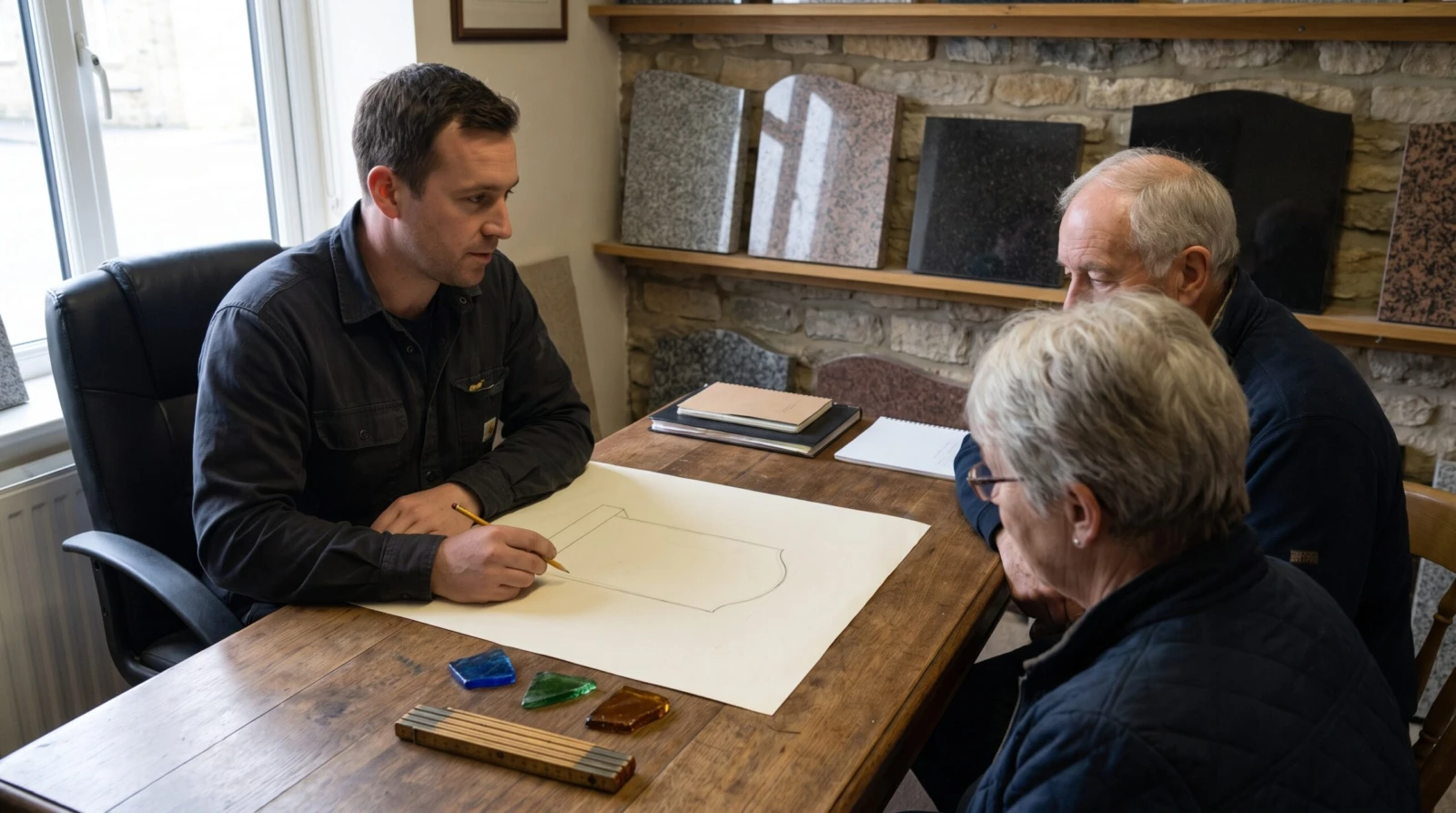
The family is sitting at the table, there is an outline of the slab on a sheet of paper, and you have things to settle that none of them has ever thought about: whether there will be a photograph, how big, on what, and whether anything else. You are doing it in the week they buried somebody.
Whether that conversation goes well comes down mostly to order. Asked too early, “would you like any decoration on it?” sounds like selling, and the answer is usually no thank you. The same question at the end, once the photograph is settled, sounds like finishing the design. What follows is a ready order of questions, the phrases that open a conversation and the ones that close it.
The principle: the photograph first, decoration after
The photograph is a decision about a person, and the family has a view on it even if they have not put it into words yet. Decoration is a decision about a piece of stone, which most families cannot picture until they see it.
So the order never changes: settle the photograph first, then show what else can be done with the space that is left. The other way round, decoration reads as an attempt to raise the bill. This way, it reads as finishing a design the family started themselves.
The second principle: a question rather than a proposal. “Would you like a photograph on the memorial?” opens the conversation. “I’d recommend crystal, it looks modern” closes it, because it puts the family in the position of having to buy or refuse.
The order of questions
Six steps. Each is one sentence, and each only makes sense after the one before:
“Would you like a photograph on the memorial?” Do not assume. Some families deliberately choose lettering alone, and that deserves respect without persuasion.
“Do you have a photograph with you, or on your phone?” Look at it there and then. It is the only moment when you can say what is possible before promising anything.
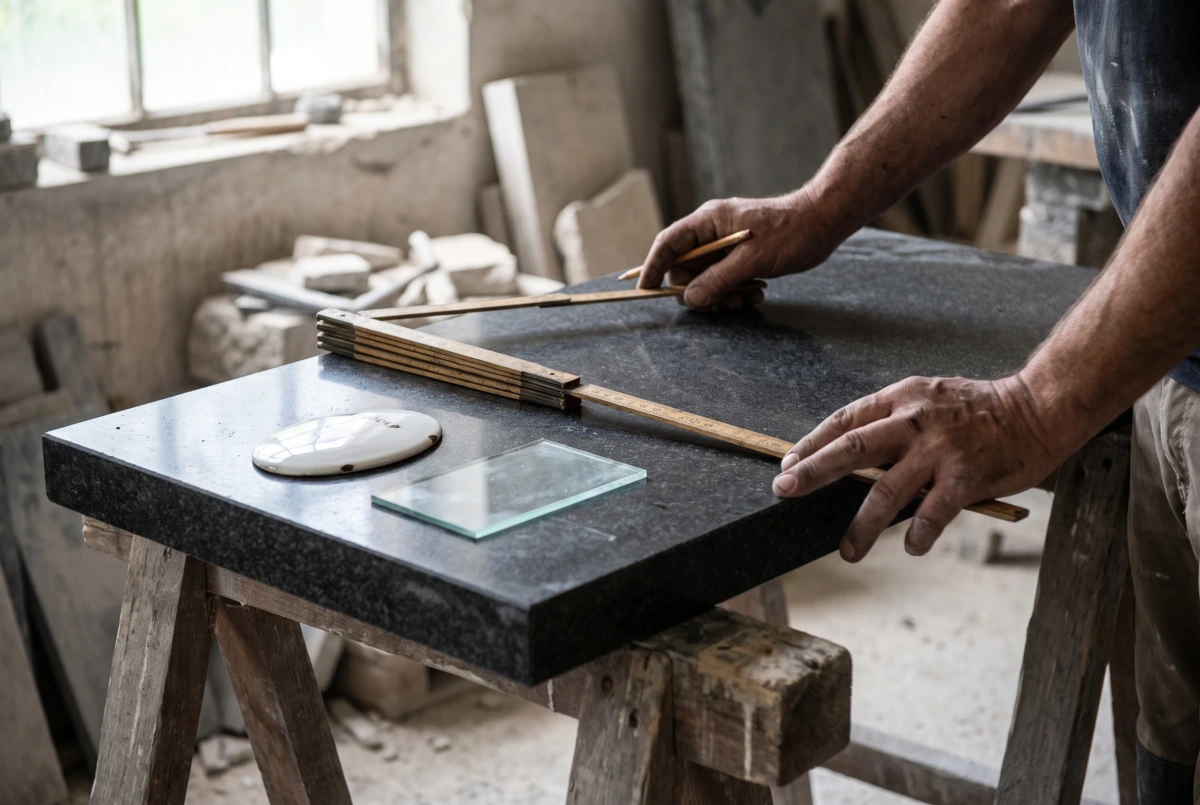
“Here is the space that is free — a photograph could be about this size, or this one.” Show it with a template against the stone, not in a catalogue.
Three sentences, one per material. Only once the family knows the size does it make sense to talk about what the photograph is made on.
“We can bond it to the face of the slab, or cut a recess and set it into the stone.” This has to be asked before the stone is worked, not after.
“There is still some space on this slab — would you like me to show you what is sometimes done there? Nothing has to be decided today.”
Settling the size of the photograph
The commonest mistake is settling the size from a catalogue. A family cannot picture what 13×18 cm looks like on a slab they are seeing for the first time in their lives.
Do it at the stone. A template is enough: a piece of card, or an offcut of glass, in two or three sizes. Hold it against the slab and the family decides in five seconds, with no need to explain centimetres.
- Measure the free field — what is left after the inscription. The photograph should sit in that space with room around it, not fill it to the edges.
- 13×18 cm fits most often on a standard upright. 9×12 cm on narrow slabs and on graves where several portraits will sit side by side.
- From 20×30 cm upwards the photograph stops being a detail and becomes the memorial — a different conversation and a different quotation.
- The proportions of the slab matter more than the size on its own. On a narrow upright a small oval looks better than a large rectangle forced into place.
A check before anyone commits to a large format: what photograph does the family actually have? A 50×70 cm portrait made from a picture the size of a stamp is a conversation better had now than after the panel is made. How to judge a file in thirty seconds is in taking photographs in from families.
One point specific to the UK: check the burial ground’s regulations before you promise a size or a decoration. Many churchyards do not allow photographic plaques at all and cemeteries often set a maximum; it is far easier to say so at the table than to unpick it later.
Porcelain, crystal or a large panel — how to explain it
The family does not need a lecture on technology. They need three sentences, one per material, and something to hold.
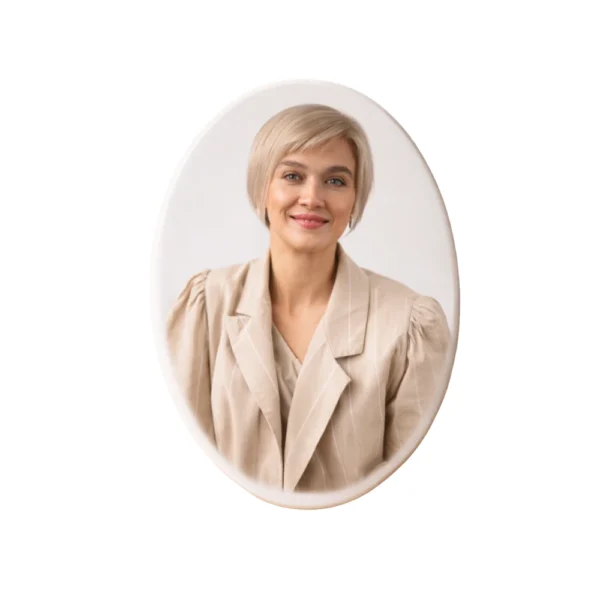
Porcelain — “this is the classic photograph, the kind you see on most memorials. Warm white, flat against the stone, oval or rectangular.” From 4×6 to 18×24 cm.
Crystal — “the same photograph, but on thick glass with polished edges. It stands off the stone and casts a shadow on it, which makes it look more contemporary.” From 8×10 to 18×24 cm.
A large tempered-glass panel — “if the photograph is to be the memorial, we make it large, with the name and the dates fired into the same sheet.” From 20×30 to 60×90 cm; more in large photo for a headstone.
All three are made in the fired ceramic process, so the colour does not fade in the sun or craze in frost. One sentence is enough for the family: “this is not a print, it is an image fired into the glass, which is why it holds its colour for decades”.
Fixing: on the face or into the stone
You ask this of the family, but the consequences are yours alone — because a recess has to be cut before the stone leaves the workshop.
- Bonded to the face of the slab. The simplest and the commonest. Porcelain goes on a flexible adhesive or stonemason’s silicone, crystal on mounting tape. No work to the stone, and it can be done later, even after the memorial is set.
- Set into a recess. The photograph drops into a milled seat and finishes flush with the stone. It looks more a part of the memorial, but the recess has to be prepared during the work, to an exact size.
- A large panel in the base or in a recess in the upright. From 40×50 cm upwards this is your structural decision: 20 mm glass when it is set in, 8 mm when it is bonded to the face.
A sentence for the family: “We can bond the photograph to the slab, or cut a seat in the stone and set it flush. The second looks quieter, but I need to know now, because the recess is made before the memorial goes up.”
Glass hearts come two ways: single-sided at 10 mm, bonded to the face, and double-sided at 20 mm, set into the stone — with the second the seat has to be planned along with the slab.
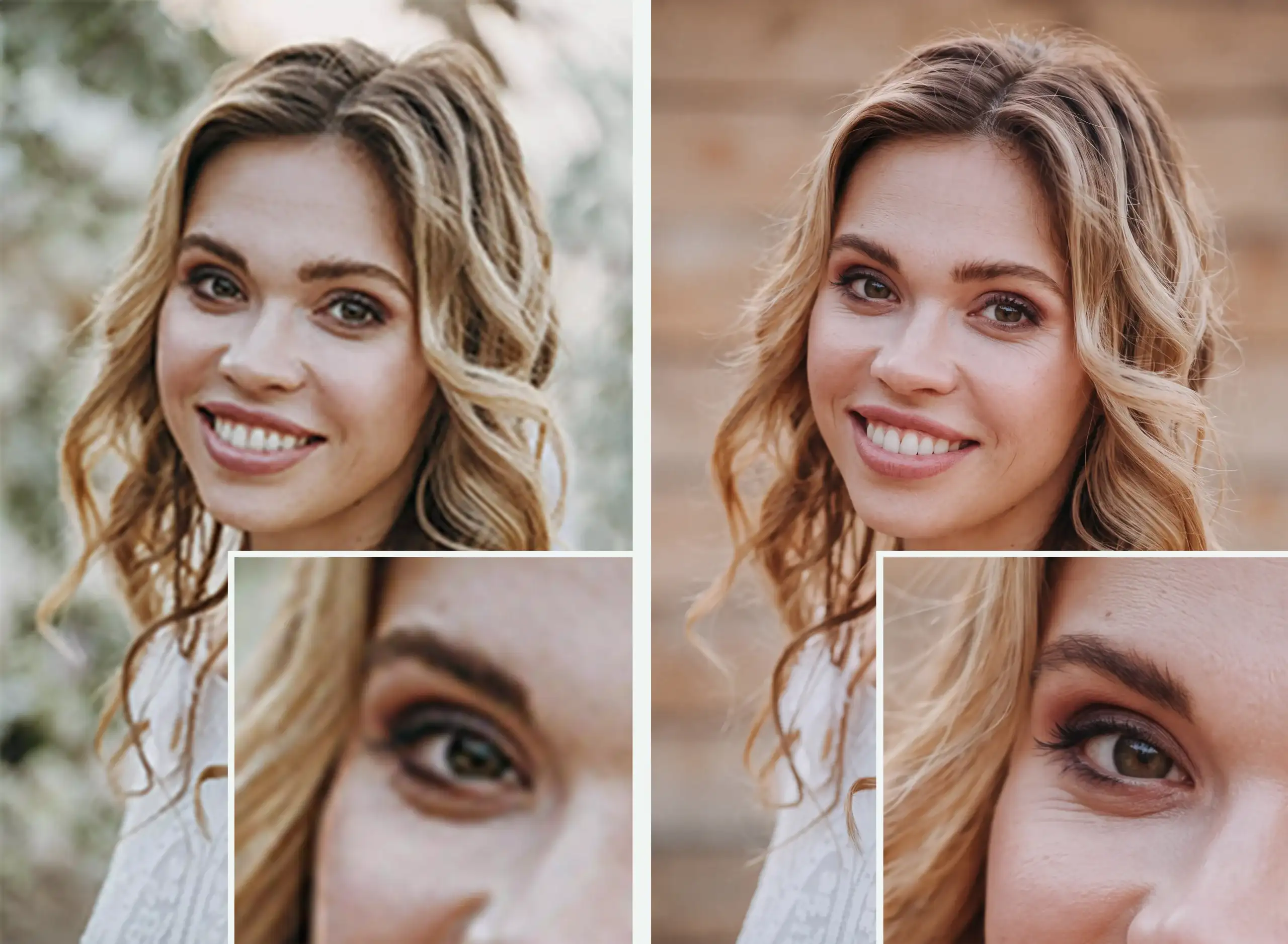
Original on the left, restored file on the right
Photo restoration
for headstones and funeral ceremonies
The service is for funeral homes, stonemasons and private individuals who need a photograph improved quickly — in time to have it printed by a local photographer for the ceremony, or prepared for use on a headstone.
We also restore photographs in very poor condition — we remove paper texture, grain and yellowing, bring back sharpness in the face and hair, and crop the frame to the format you choose. We hand over the print-ready file as a link you download to your computer.
Decoration: a heart, a cross, a stained-glass panel
You only reach this point once the photograph is settled. Showing beats describing — three pictures on a tablet, or a sample of glass in the hand, does more than ten sentences.
The opening line: “There is still some space on this slab. Would you like me to show you what is sometimes done there? Nothing has to be decided today.” The last sentence matters most — it takes the pressure off, and it is usually the one that makes a family ask to see.
- A glass heart — “one of the commonest choices when a family wants something warmer than stone alone.” Four sizes from 15×13 to 30×26.5 cm, double-sided, 20 mm thick, made to be set into the stone.
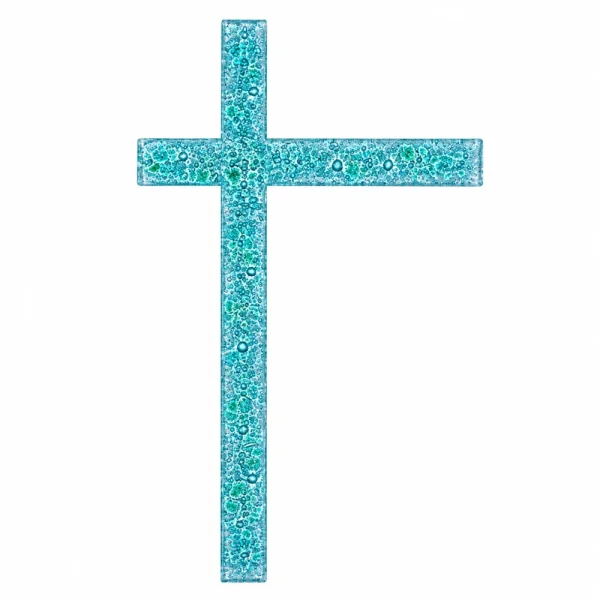
- An asymmetrical cross in fused glass — “a cross that is not cut into the stone but set in as a separate piece, in colour.” The cross is sized to the slab: 56×66 cm for a 60×70 cm slab, 56×81 cm for a 60×85 cm one.
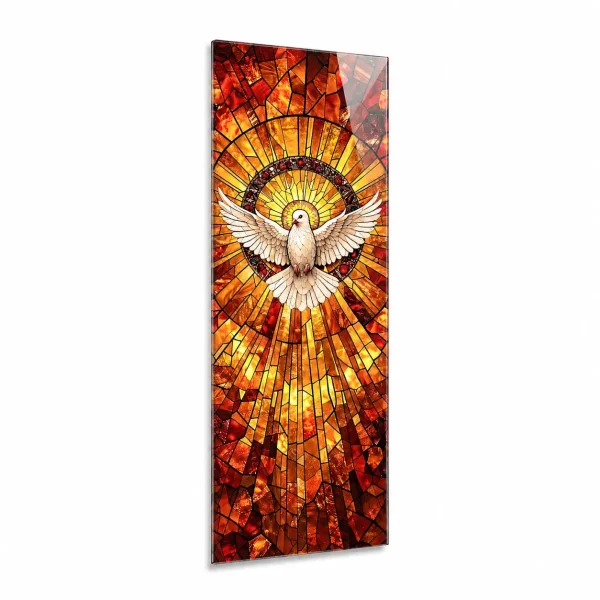
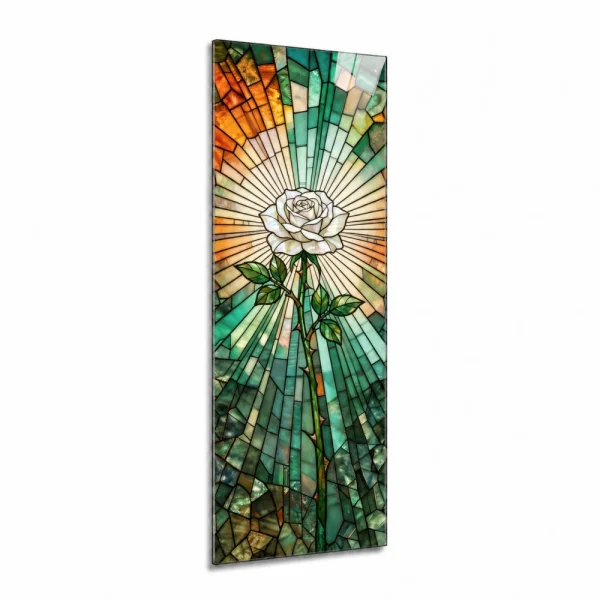
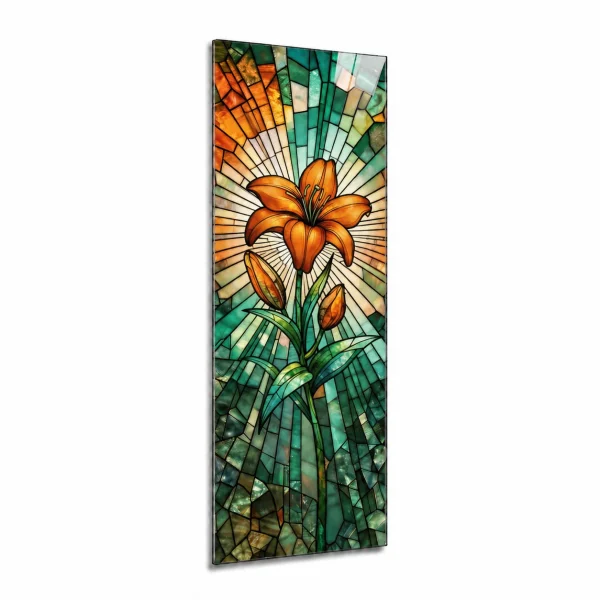
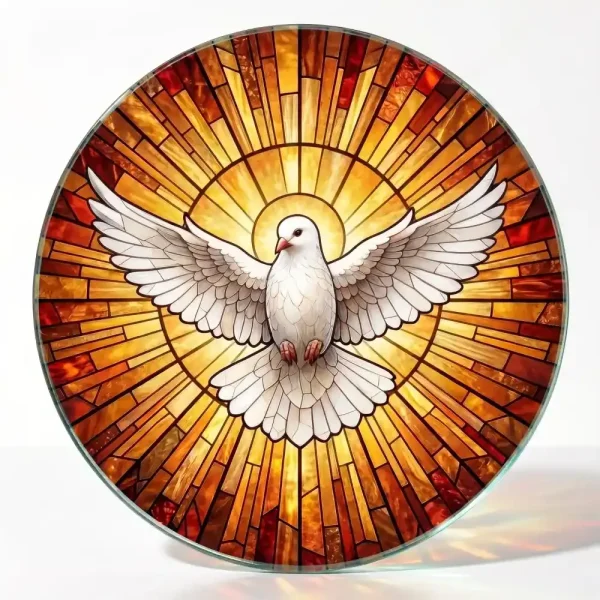
- Stained-glass and decorative panels — “an upright panel in the stained-glass style, or a round one with a motif.” Upright panels from 16×45 to 22×60 cm, in 8 or 10 mm, with or without light coming through.


Swipe to see the rest. Each picture opens the product.
The full range is in glass hearts, asymmetrical crosses, stained-glass panels and glass panels.
Phrases that work, and phrases that close the door
The difference is almost always whether the sentence leaves the decision with the family or forces it:
- “Would you like a photograph on the memorial?”
- “Here is the space that is free — I can show you two possibilities.”
- “Nothing has to be decided today; there is time before the design.”
- “I can prepare it two ways and send them over for you to look at.”
- “If you would rather have the lettering on its own, that is a common choice too.”
- “I’d recommend crystal, everyone has it now.”
- “For a little more I can add a cross and a heart as well.”
- “Lettering on its own will look rather bare.”
- “You need to decide today or we won’t get it done in time.”
- “It’s only a couple of hundred more.”
When the family cannot decide
This is the commonest situation and it is not a problem — pushing for a decision at that moment is. Three things that help:
- Narrow it to two options. Given five possibilities a family postpones; given two, they choose. “I’ll prepare two versions for you: the photograph on its own, and the photograph with a cross.”
- Offer a drawing to look at. A sketch or a visual sent by email does more than a description across the table. They will look at it in peace, without you sitting opposite.
- Say honestly when they can still change their mind. “Until we start working the stone, anything can still be changed.” It is true and it takes the tension out.
If the family says “I don’t know, perhaps just the photograph”, that is a decision — take it and do not return to the subject. The firm that does not push is the one they remember for the next memorial in the family.
What not to promise at the table
A promise made in conversation costs more than a correction in the workshop. Four things where “let me check and call you back” is the better answer:
- The result from a very poor photograph. Not “we’ll make it look as good as new” but “I’ll send this to be checked and tell you tomorrow what will come of it”.
- The timing on a large format. The design comes back in two to three days, but the whole order is usually three to six weeks.
- A non-standard size without a quotation. Panels and crosses are made to measure, and the price follows the size — better given tomorrow than guessed today.
- A colour “exactly like the one on the website”. Fused glass varies naturally; with colour it is always worth showing a sample.
Difficult photographs can be sent to img@deseomemorials.com to be checked before any order is placed. The whole run from taking a photograph in to a finished portrait is in the family brings a poor photograph.
The crib sheet
- Ask whether there is to be a photograph at all. Do not assume.
- Look at the photograph there and then — phone, print, whatever they have with them.
- Settle the size with a template at the stone, not from a catalogue.
- Explain the material in three sentences and show a sample.
- Settle the fixing now — the recess is cut before the memorial goes up.
- Only at the end, ask whether to show what else can be done with the space.
- Finish with “nothing has to be decided today”.
Frequently asked questions
Where do we start the conversation about a photograph?
With whether there is to be one at all. Size, material and fixing come after that.
When do we show the decoration?
At the end, once the photograph is settled, and as a showing rather than an offer: “nothing has to be decided today”.
How do we settle a size the family will understand?
With a template at the stone. A piece of card in two sizes works better than any table of figures.
When does the recess have to be decided?
Before the stone is worked. Once the memorial is up, only bonding to the face is left.
Can a glass heart be bonded to the face?
Yes, in the single-sided 10 mm version, which is backed with colour. The double-sided 20 mm version is made to be set in, so with that one plan the seat along with the slab.
How do we size the cross?
To the slab: 56×66 cm for a 60×70 cm slab, 56×81 cm for 60×85 cm. Give us the slab size and we will match the cross.
What if the family cannot decide?
Narrow it to two options and offer a drawing they can look at at home.
Do you make sizes outside the list?
Yes, for photographs, panels and crosses. Send the dimensions and we will quote.
Recommended products
The pieces that are easiest to show a family at the table:
We will send templates and materials to show families, quote a non-standard size and set out the terms of a standing arrangement.
+48 789 024 384biuro@deseomemorials.com
Porcelain photos