A PDF catalogue and a demonstration set in the workshop

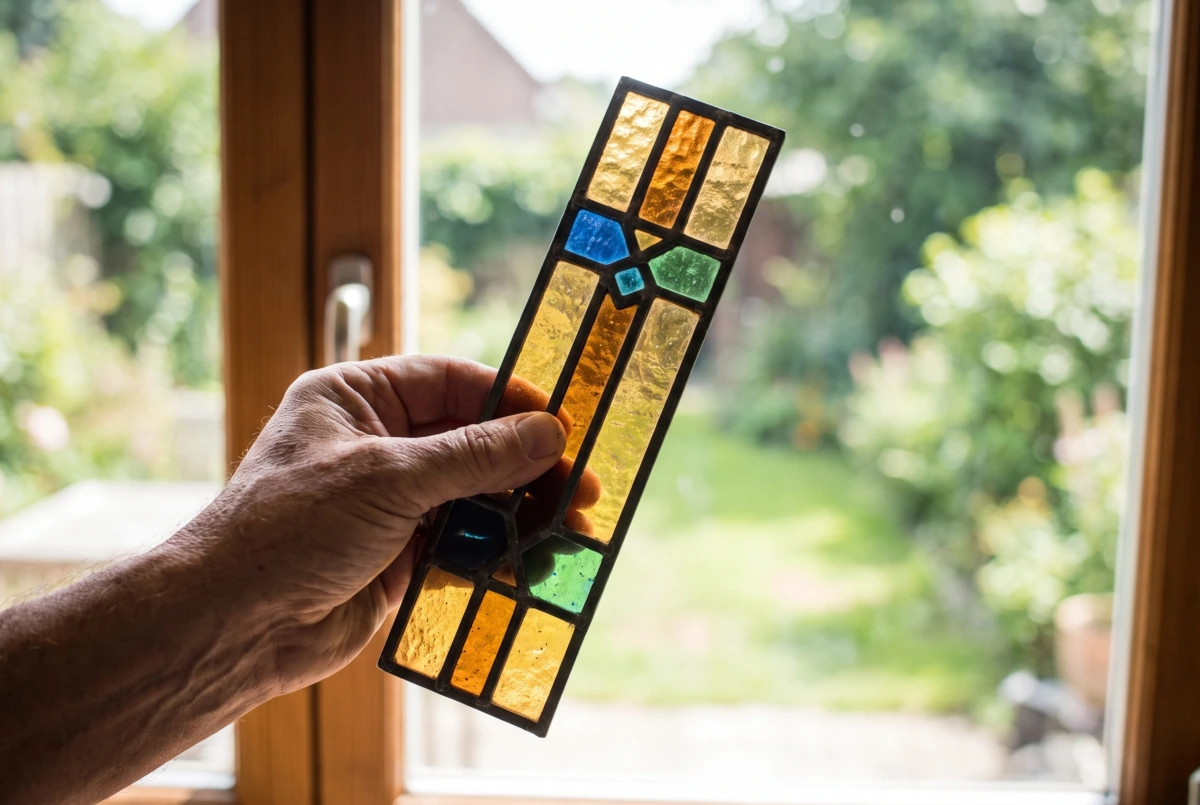
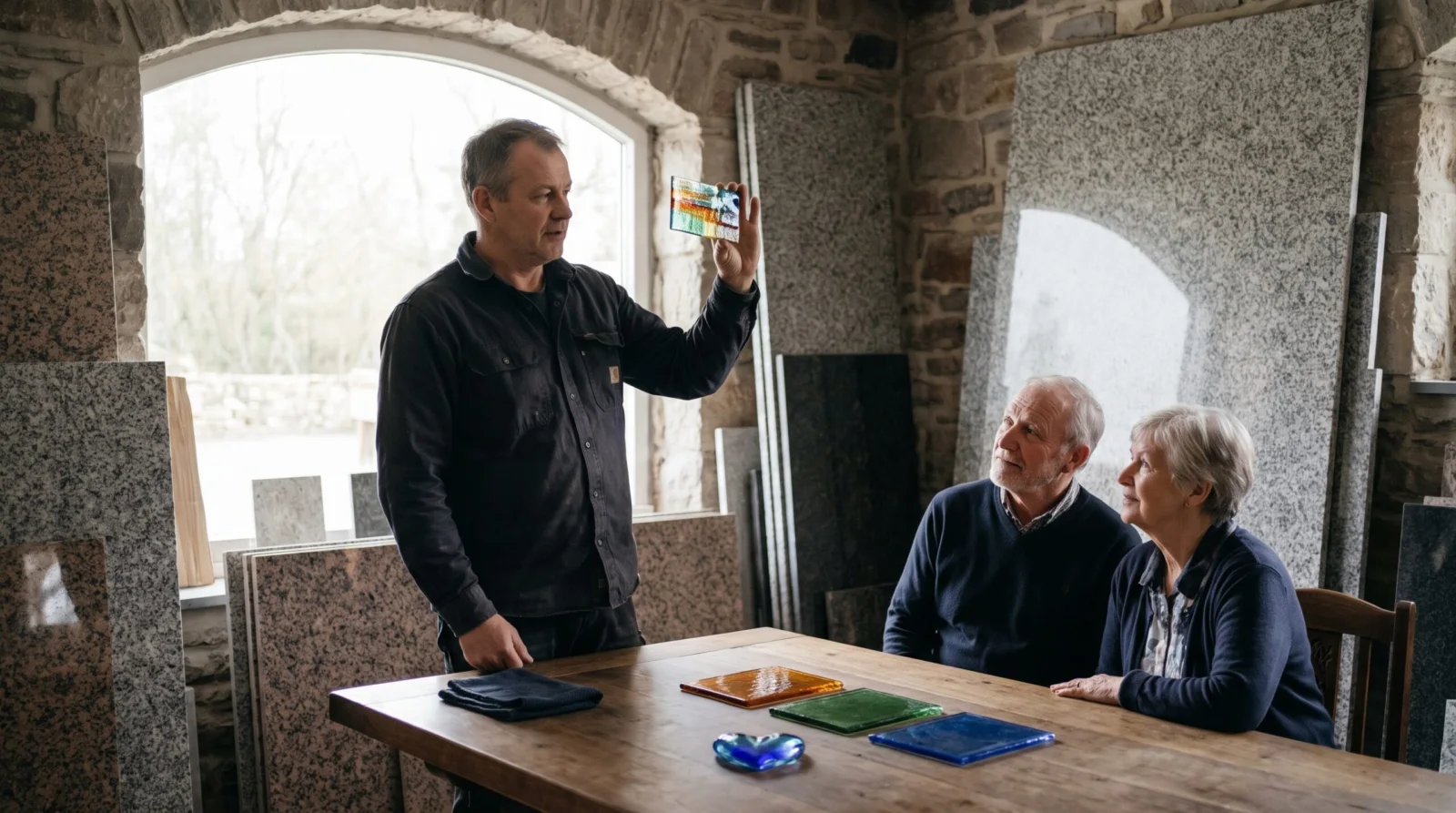
A mason shows a family a coloured glass sample held up to the window light
For masons
A PDF catalogue and a demonstration set in the workshop
Glass in a photograph looks like a sticker; held up to the light it looks like something people pay for. What to put in the set and how to show it.

Published 9 November 20268 min read
Contents

A glass decoration in a catalogue photograph looks like a sticker. The same piece held up to the window looks like something people pay several hundred pounds for. The difference is not in the product but in how it is shown — and that is the only reason it is worth spending half a day putting a demonstration set together.

This is about things you can do in the workshop in one day: what should be on the table, how to show it, what a PDF catalogue is actually for, and what not to send the family home with. The order of the conversation itself is covered separately in talking to families about the photograph and the decoration.

Why a catalogue on a screen is not enough

Glass is a material that does not exist without light. A photograph shows the colour and the shape, but not the four things that actually decide it:

  • How the colour works. Fused glass changes its shade with the angle and with the time of day. On a screen it is one flat colour; in the hand it is several.
  • What light coming through does. A panel that passes light and a panel with a white backing look identical in a photograph and completely different on a memorial.
  • The thickness. No photograph shows the difference between 8 mm and 20 mm glass, and it decides both the price and the way it is fixed.
  • How big it is. A family looking at a phone does not know whether a heart is 15 or 30 centimetres across — and those are two different decisions.

Hence a simple rule: the catalogue is for choosing a design, the sample is for making the decision. Swap those roles and you get a family who say they will think about it and never come back.

A hand holding an upright stained-glass sample against the window light
Light coming through only shows against a window — in a catalogue photograph the same panel looks flat.

The demonstration set: what should be in it

This is not about a cabinet holding the whole range. It is enough that a family can pick up a piece of glass and see the difference between two options:

The minimumSix things that settle the conversation
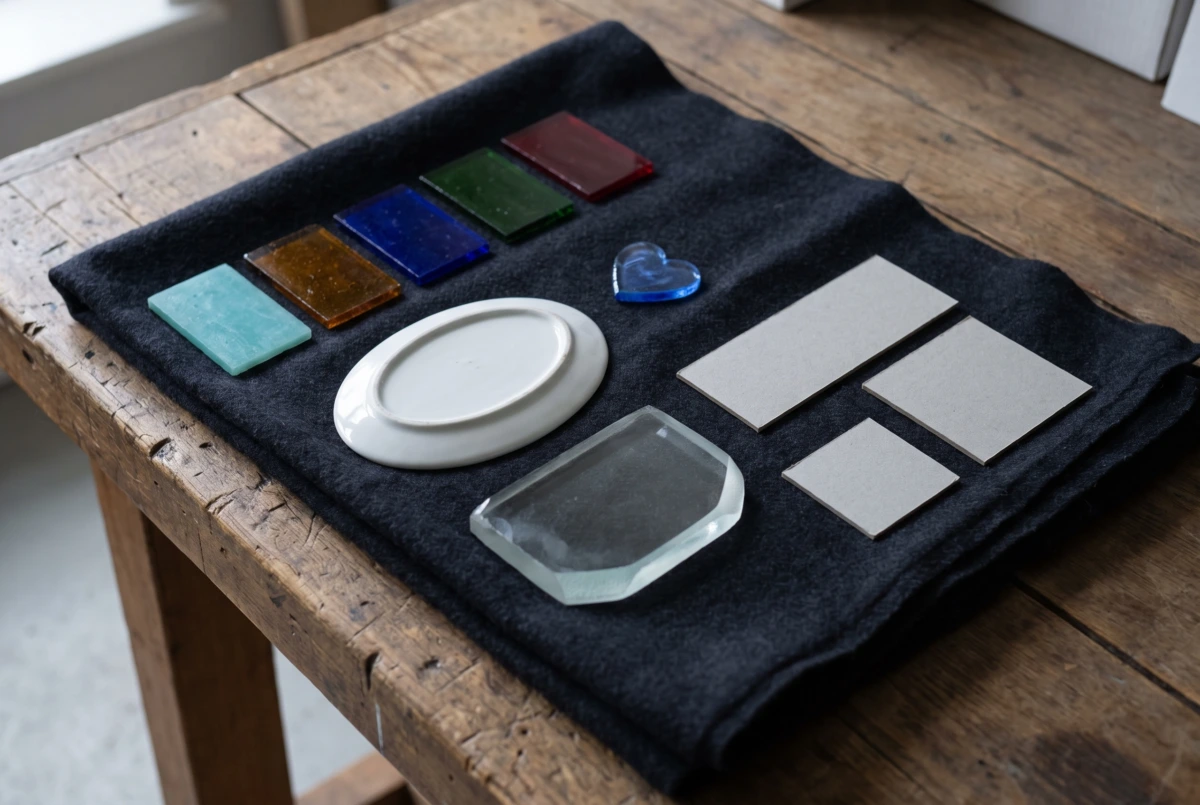
  • Four or five samples of coloured fused glass — one from each colour family the crosses are made in.
  • One small glass heart, ideally 15×13 cm — it shows the thickness, the double-sided finish and how colour works inside the body of the glass.
  • An offcut of a stained-glass panel, and it has to be the version that passes light.
  • A porcelain and a crystal sample — a small photograph on each, side by side.
  • A piece of 8 mm and a piece of 20 mm glass — thickness alone, no pattern.
  • Three card templates: 9×12, 13×18 and 20×30 cm.
Worth addingIf you have the room
  • An offcut of dark granite as a base — on it, glass looks the way it will on the memorial rather than the way it looks on a pale desk.
  • A piece of dark felt or cloth to lay across the table.
  • A tablet with the catalogue on a stand, rather than passed from hand to hand.
  • A damaged sample — glass with a chip shows honestly what can happen.
A set of samples: coloured fused glass, a heart, porcelain, a thick offcut and card templates
The whole set fits on one piece of dark felt and costs less than a single lost order.

How to show it

Four habits that change how the same set is received:

  1. Always against the light. With panels that pass light this is not showmanship, it is the only way to show what the family is paying for. Stand with the window behind you and hold the sample at their eye level.
  2. On a dark background. Coloured glass on a pale worktop loses half its depth. Dark felt or an offcut of granite costs very little and the difference is immediate.
  3. Put it in their hands. Glass has a weight and a coolness that cannot be shown any other way. A family who have held a sample for a minute decide twice as often.
  4. At the stone, not at the desk. If you have a slab in the yard or the workshop, hold the sample against it. Size and colour are judged in the setting the decoration will live in.

One thing not to do: do not lay everything out at once. With a dozen samples on the table a family stops choosing and starts drifting. Show two at a time and ask which is closer.

A display piece in the yard

A sample in the hand settles colour and texture. What a sample cannot show — how a decoration looks in the whole mass of a memorial, how it changes through the day, how it sits next to an inscription — only one finished piece in the display yard will answer.

That is a separate part of working with us: a glass panel, a stained-glass panel or a large photograph on your own display memorial, to be seen in person. A family who come to look at granite see, in passing, what else can be done with it — without any selling on your part.

It is worth choosing one piece rather than three: the one that comes up most often with your customers. On contemporary dark memorials that is usually an asymmetrical cross or a large photograph on glass; on traditional ones, a stained-glass panel.

The PDF catalogue — what it is really for

A catalogue is not a selling tool but a tool for choosing a design. A family who were sent a file instead of a conversation usually never open it.

  • In the workshop: on a tablet, on a stand, scrolled through together. Do not hand over your phone with your own photographs — it looks improvised.
  • After the conversation: send a link, not the file. The main catalogue is a large document and will not go through most mailboxes; a link opens on a phone straight away.
  • A few pages, not all of them. Instead of sixty pages, send the two or three items you actually discussed. A choice between three comes back with a decision; a choice between sixty does not come back at all.
  • The printed version: once we are working together we send a printed catalogue. In a room where a family sits down at a table, paper works better than a screen.

Ask us for the current catalogue, and about a trade account with discounted prices, on the cooperation page.

A headstone photograph before and after restoration Original on the left, restored file on the right

Photo restoration
for headstones and funeral ceremonies

The service is for funeral homes, stonemasons and private individuals who need a photograph improved quickly — in time to have it printed by a local photographer for the ceremony, or prepared for use on a headstone.

We also restore photographs in very poor condition — we remove paper texture, grain and yellowing, bring back sharpness in the face and hair, and crop the frame to the format you choose. We hand over the print-ready file as a link you download to your computer.

Drag your photo hereJPG, PNG, WEBP, TIFF — up to 64 MB Choose file
€21,00
standard, within 72 hours
€39,00
express, within 24 hours
Go to the service

What to send the family home with

A conversation in the workshop almost never ends in a decision the same day — and that is fine. What the family get on their phone on the way home decides whether they come back.

The set that works best has three parts and fits in one message:

  1. Two or three links to the particular products you discussed — not to a whole category.
  2. One sentence on price and timing: what the chosen option costs and how long it takes. Without it they will ring to ask anyway.
  3. A drawing or a visual, if you have one. Even a phone photograph of your sketch beats nothing.

What not to send: the whole catalogue with no comment, pictures from the internet of things you do not offer, and a price list for everything. Each of those moves the decision from “which of the two” to “whether at all”.

Five mistakes that cost an order

  • Keeping the samples in a drawer. A set you have to walk to the office for will not come out in half the conversations. It belongs where the family sits down.
  • Showing everything at once. Twelve samples is not a choice, it is noise. Two at a time, then two more.
  • Showing it under strip lighting. Fluorescent light in a workshop kills the colour of fused glass. With no window, use a warm lamp and hold the sample under it, not beside it.
  • The catalogue instead of the sample. A screen is enough for choosing a motif, never for deciding on a material.
  • No size in the conversation. A family who never saw a 13×18 cm template against the slab choose a size by guesswork and are usually surprised later.

What you can get from us

The demonstration set and the catalogue are two of the parts that can be settled in one conversation. On the cooperation page you pick only the ones that interest you:

  • A trade account with discounted prices and catalogues. Prices once you are logged in, the catalogue as a PDF, and a printed one once we are working together.
  • Display pieces for your yard. A glass panel, a stained-glass panel or a large photograph on your own memorial, to be seen in person.
  • Customers from your area. Enquiries that come to us are passed to the partner in that region.
  • Graphic support. Print-ready files from old photographs, advice on materials and fixing.
  • A website for the firm — for businesses that do not have one yet.

We work with a small number of partners in each region, so the terms are agreed individually, by phone or by email.

What most often goes into the set

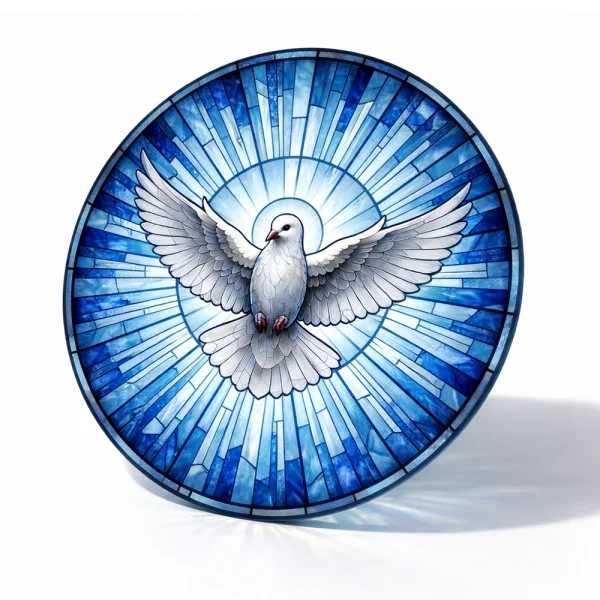
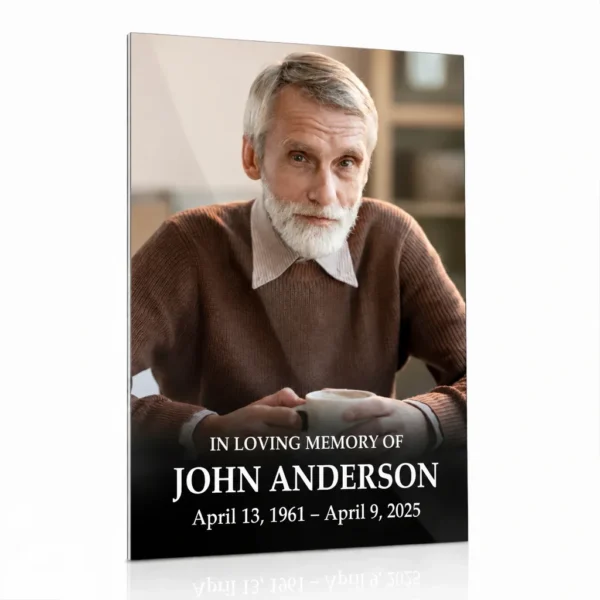
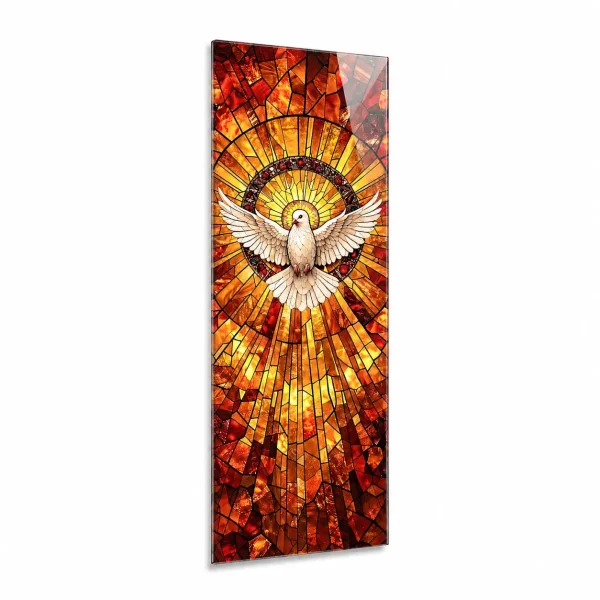
The four pieces that work best in a demonstration set — each picture opens the product:

Frequently asked questions

What does a demonstration set cost?
The scope and the terms are agreed individually — the simplest thing is to call and say what comes up most often with your customers. Details on the cooperation page.

Where should the samples be kept?
Where the family sits down. A set in a drawer in the office will not come out in half the conversations.

Is the catalogue on its own enough?
For choosing a motif, yes. For deciding on the material, the thickness and whether light passes through, no.

How should we send the catalogue to a family?
As a link, not a file. The main catalogue is a large document and will not go through most mailboxes.

Do we get a printed catalogue?
Yes, once we are working together. It goes out along with the terms.

If we can only put one thing in the yard, what should it be?
Whatever comes up most often with your customers: an asymmetrical cross or a large photograph on contemporary dark memorials, a stained-glass panel on traditional ones.

Do you help with photographs from families?
Yes, that is a separate part of it: restoration and print-ready files from old photographs. Details on the service page.

The crib sheet

  1. Keep the set where the family sits down, not in a drawer in the office.
  2. The minimum: a few fused-glass samples, a small heart, an offcut of a light-passing panel, porcelain and crystal, two thicknesses of glass, three size templates.
  3. Show it against the light, on a dark background, and put it in their hands.
  4. Two samples at a time, never all of them.
  5. Check the size with a template at the stone.
  6. The catalogue on a tablet for choosing a design; send a link and two or three specific products home.
  7. If you can put one piece in the yard, make it the one that comes up most often.
Working with usGet in touch with us

We will agree the scope, put together a catalogue and a demonstration set matched to what you actually sell.

+48 789 024 384biuro@deseomemorials.com
Share this article

← All posts