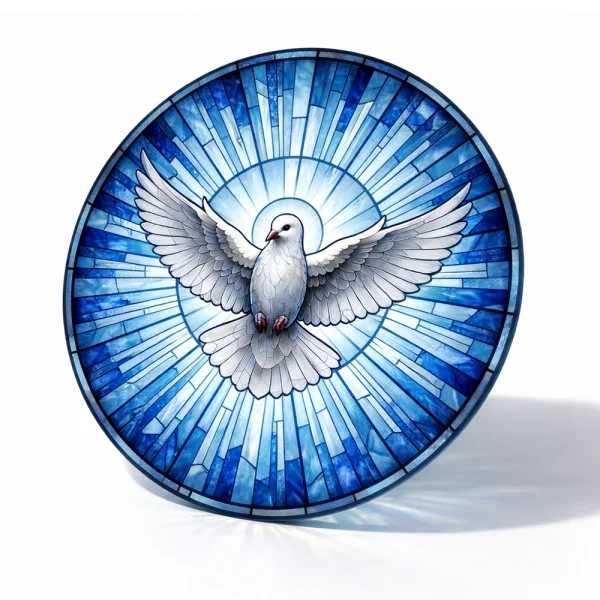
Earning more on a memorial with glass decoration

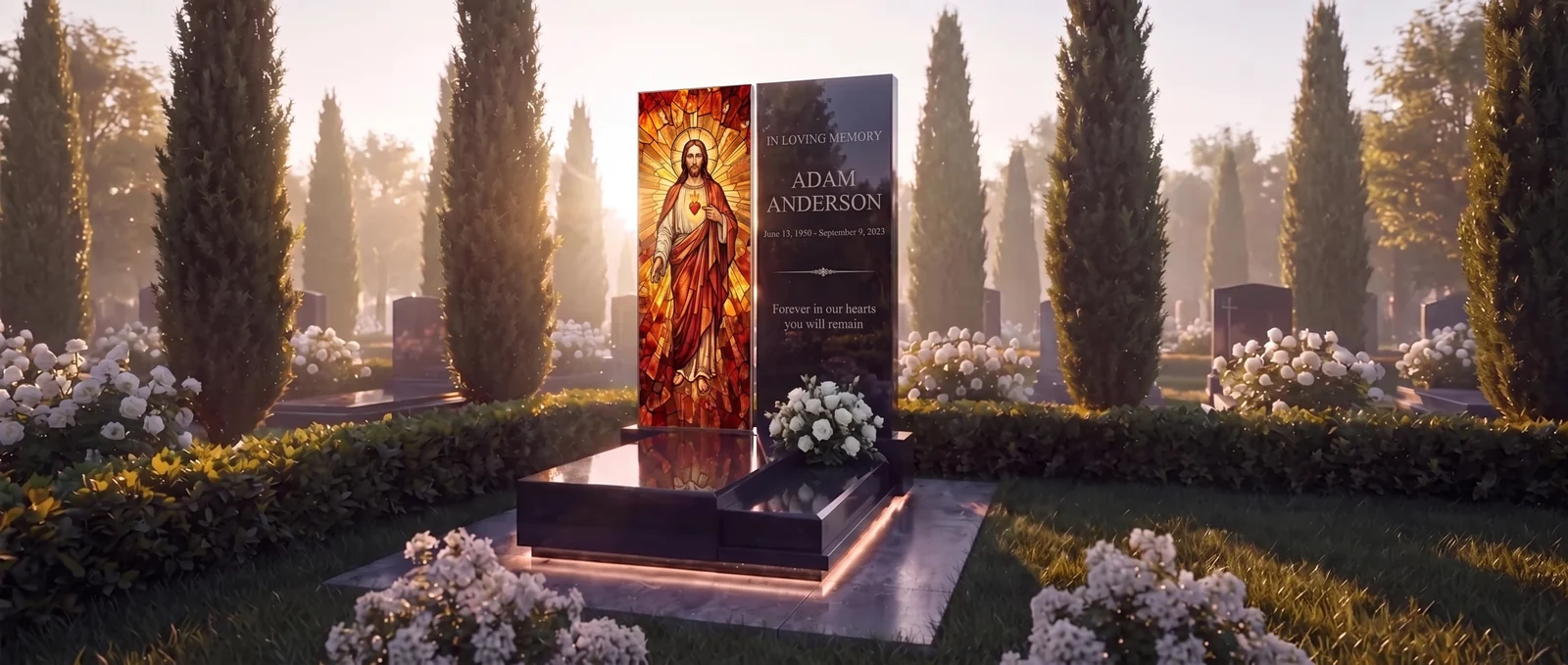
Headstone with a Sacred Heart of Jesus stained glass panel and an engraved tablet, surrounded by cypress trees at sunset
For masons
Earning more on a memorial with glass decoration
The same granite, the same lettering, five hundred euro of difference. Where it comes from and how to work it out on your own quotation.

Published 19 November 202611 min read
Contents

Two memorials stand side by side in the same yard. The same slab, the same granite, the same lettering. One costs the family two and a half thousand, the other three. The difference is not in the stone — it is one coloured element that the second memorial has and the first one does not.

This is about where that difference comes from and how to work it out on your own quotation. Not about whether glass is worth offering — that was adding glass to a memorial mason’s offer. This is the arithmetic: what actually stays with the workshop, which arrangement leaves more, and why with some products you earn on the stone you did not buy while with others you earn on something else entirely.

The wow effect, or what the family is paying extra for

A cemetery is grey. Granite, kerb, gravel — and then one element that breaks the light. A family who sees it does not compare it with anything, because there is nothing to compare it with.

Three things decide, in practice, that a family pays for glass without haggling:

  • It is the only colour there is. A memorial is restrained by definition. Coloured glass is the one place where it is allowed to be warm — and families feel that even when they cannot name it.
  • They cannot price it against three other yards. A family will check the price of a 60 × 80 slab at your competitors in half an hour. The price of a 25 × 70 light-transmitting panel they will not check, because nobody else nearby has one.
  • It is the only thing they choose themselves. The stone, the thickness, the foundation — those are your decisions, which the family neither understands nor wants to. The colour of the glass they choose in their own name. That is why they grow attached to it, and why they defend it when someone in the family says it would do without.

This is not a trick for getting more money out of people. A family who wanted something of their own gets it, and the workshop gets paid for it. The only problem is that in most workshops the conversation never happens at all.

Three mechanisms, not one

“Glass raises the price of a memorial” explains nothing. There are in fact three different arrangements, and in each the money comes from somewhere else. The distinction matters, because in one you earn on stone you did not buy, and in another you are adding labour:

Mechanism AGlass instead of stone
  • Applies to rectangular panels set into the mass, in 20 mm.
  • The field the panel fills does not have to be made in granite: the stele is narrower or split, and the glass closes the composition.
  • You buy less stone and you work less of it.
  • Material cost down, value of the memorial up — the only arrangement where both move at once.
Mechanism BGlass on stone
  • Applies to 8 mm glass bonded on, single-sided 10 mm hearts and large photographs.
  • The same stone, a solid slab, no change to the design.
  • Labour: degreasing and beads of adhesive, sometimes a shallow milled recess.
  • A clean addition to the quotation at an almost unchanged cost of building the memorial.
Mechanism CGlass in the mass
  • Applies to double-sided 20 mm hearts and asymmetrical crosses.
  • The same stone, but the slab has to be prepared: a milled channel for the cross, a through-seat for a heart that reads from both sides.
  • Labour clearly up — and that has to go into the quotation rather than be passed over.
  • The price of the element is higher too, usually by more than the extra work costs. But only if someone works it out.

Where the money actually is

Start with the thing that is easy to get wrong. The trade discount is a floor, not a ceiling. You see your own price once you are logged in to a trade account, and that is the starting point rather than the goal — on its own the discount makes no hundreds.

What you earn on one job is made of four things:

stone saved  +  trade discount  +  your markup  −  extra labour

The largest of the four is almost always the markup — because the glass element enters the quotation as a line the family cannot set against anyone’s price list. Second largest can be the stone, but only in mechanism A and only on one condition.

The condition without which the stone saving does not exist

The saving appears when the memorial is designed with glass from the start. The stele is narrower, split, or has a planned gap, and the panel closes it — then you genuinely buy less granite.

If instead you cut an opening in a slab that was already designed, you save nothing: you pay for the whole material and then for the cutting and the edge work on top. That is the same job as always, plus one more. Which is why the decision about glass has to come before the design, not after it.

Worked out on three memorials

Three typical jobs, one per mechanism. In each we assume you add €250 of markup on the glass element — a number to replace with your own, but it shows how the result shifts with the arrangement.

1. A memorial with a 25 × 70 cm panel, set in (mechanism A)

  • The panel enters the quotation together with your markup — say €250.
  • 0.175 m² of granite leaves the slab — at €200 per square metre of finished slab that is around €35 less material. Use your own rate.
  • Labour: two plinths instead of a solid field. Comparable work, since the edges have to be milled and polished either way.
  • Stays with the workshop: over €285 — the markup, the stone you did not buy, and the difference between your price and the shop price.

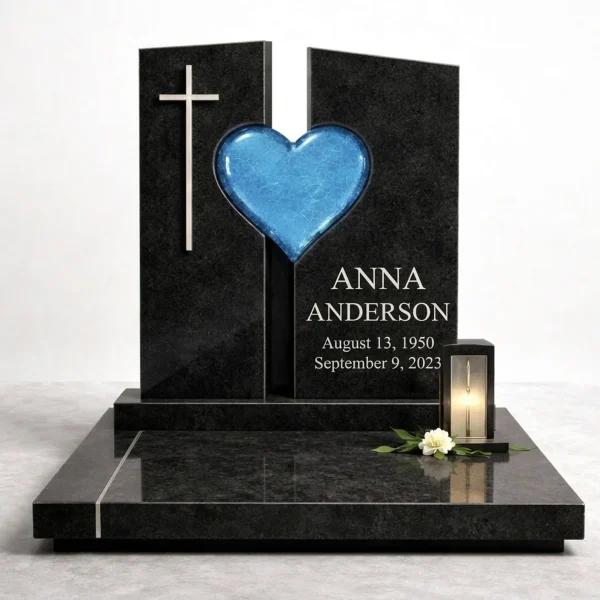
2. A memorial with a single-sided 20 × 17.5 cm heart (mechanism B)

  • The heart enters the quotation with the same €250 markup.
  • Stone unchanged — the slab is solid, exactly as it would be without the heart.
  • Labour: degreasing and beads of adhesive, or a shallow recess if you want it flush. Half an hour, not half a day.
  • Stays with the workshop: over €250 at a practically unchanged cost of building the memorial — the cleanest of the three arrangements.

3. A memorial with a 56 × 71 cm asymmetrical cross (mechanism C)

  • The cross enters the quotation with a €250 markup.
  • Stone unchanged, but a channel has to be milled in the slab — and that is real work that has to be added.
  • Stays with the workshop: the markup and the price difference, less the cost of that channel — and this is the one arrangement where the “less” can eat a good part of the gain if nobody worked it out before quoting.

The conclusion is simpler than it looks: mechanisms A and B earn on their own; mechanism C earns only when the extra labour made it into the quotation.

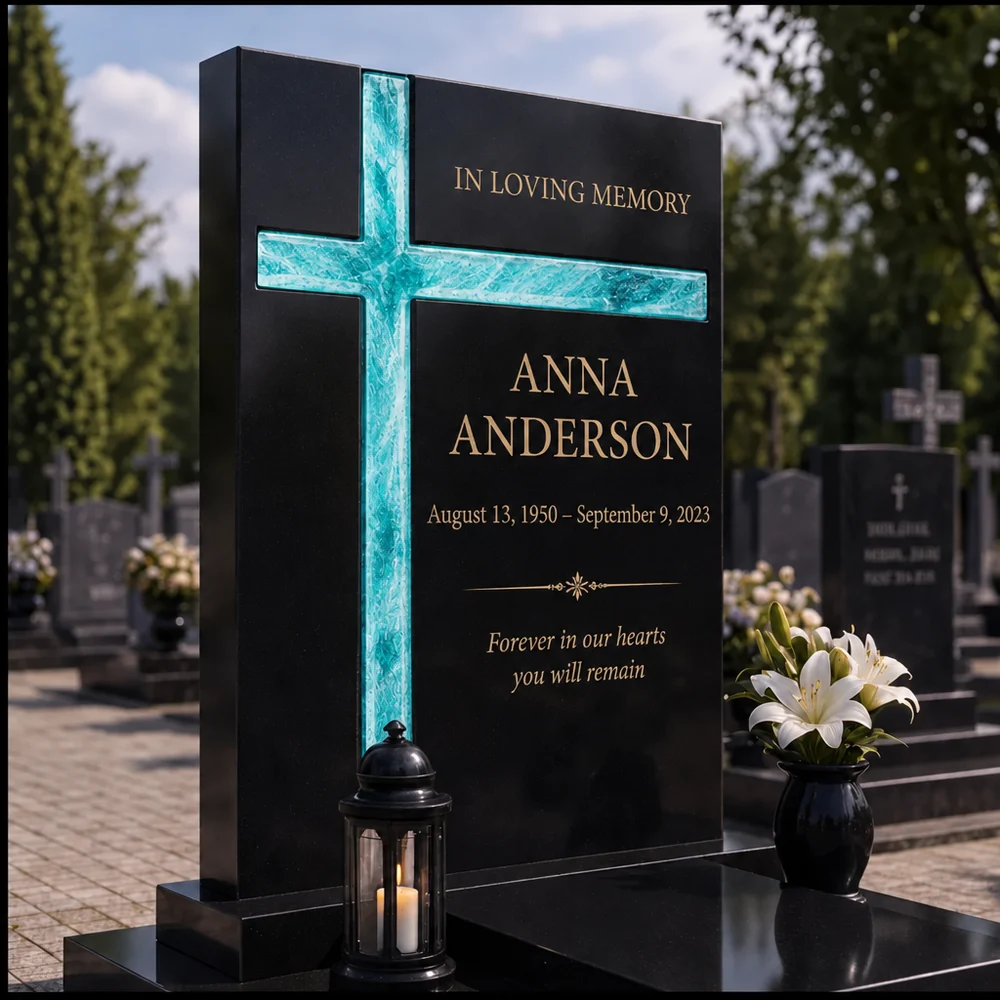
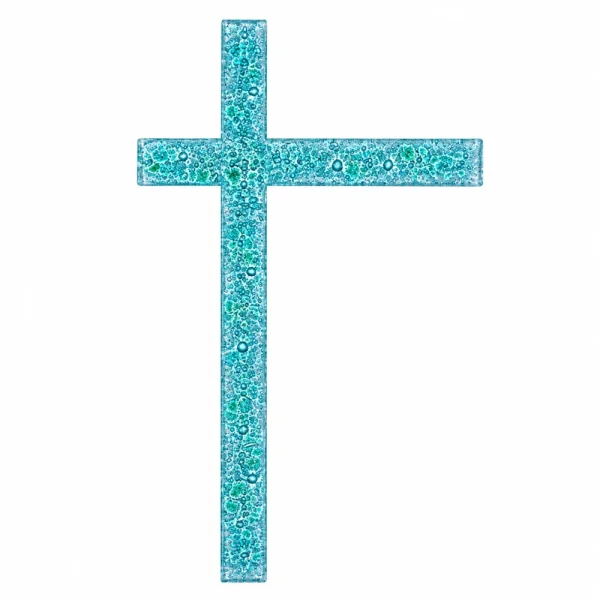
Asymmetric fused-glass cross mounted on a granite headstone
A cross set into a milled channel — mechanism C: the same stone, more work, a higher price for the element.

Hearts: single-sided against double-sided

This is where it is easiest to lose money, because the difference in work is far bigger than the difference you can see in a catalogue.

A double-sided heart is 20 mm thick with the pattern reading from both sides. For that to mean anything the slab needs a through-seat, finished and polished on both faces, planned along with the memorial. That is not a recess — it is a change to the structure of the main slab.

A single-sided heart is 10 mm with a coloured backing, so the stone does not show through. It goes on the face of the slab: either simply bonded on with an elastic adhesive, or into a shallow recess if you want it flush. Either is a fraction of the work of a through-seat.

The double-sided version costs noticeably more than the single-sided one in the same size. The question is whether that covers the difference in slab work at your end. In practice:

  • A standard memorial — single-sided earns better. Less work, less risk, the same effect from the front, since the back of the memorial is looked at by a hedge.
  • A premium memorial, a split stele, or one standing in a walkway — double-sided. There it really is seen from both sides, the family will pay for it, and you have a reason to quote the slab preparation as a line of its own.

Panels: 20 mm in a plinth or 8 mm on the slab

The same design, two completely different sums. The decision is not about price but about whether the field is cut out of the stone or left solid.

  • 20 mm, set into plinths or a side channel. This is mechanism A: the field it fills does not have to be made in granite. The light-transmitting version only makes sense here — a panel needs somewhere to get its light from.
  • 8 mm, bonded to the face of the slab. Mechanism B: the slab stays solid, and degreasing and adhesive are added. The backed version, because there is stone behind it.

The difference in purchase is small. The difference in what stays with the workshop can be much larger — because with 20 mm there is also the stone you did not buy.

A large photograph: most effect for least work

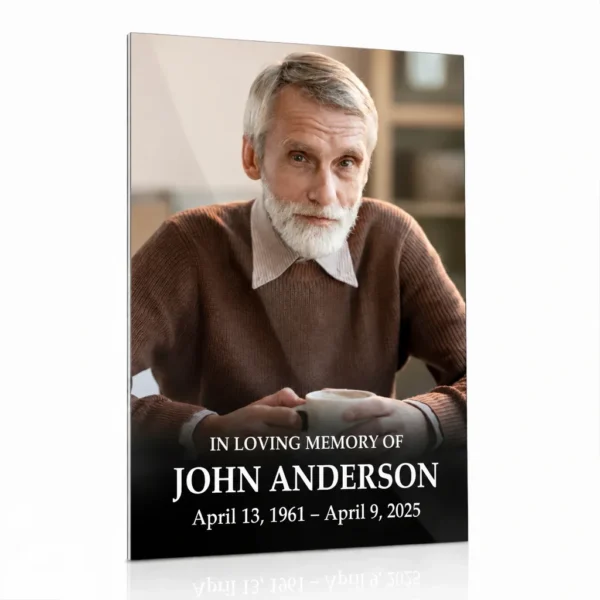
A large photograph on tempered glass at 40 × 50 cm, in 8 mm, is bonded to the slab. It is the simplest fixing of the lot and at the same time the element that makes the biggest impression — because it is a portrait and a decoration at once.

  • 8 mm is chosen for bonding, 20 mm for setting into a plinth. The latter costs more, and the whole difference buys the method of fixing, not the appearance.
  • You can price it yourself in seconds in the large photograph calculator, at the desk, on a phone. A logged-in partner sees their own price next to the retail one.

A poor photograph from the family is not a reason to drop a size — that we handle separately, on the service page.

A headstone photograph before and after restoration Original on the left, restored file on the right

Photo restoration
for headstones and funeral ceremonies

The service is for funeral homes, stonemasons and private individuals who need a photograph improved quickly — in time to have it printed by a local photographer for the ceremony, or prepared for use on a headstone.

We also restore photographs in very poor condition — we remove paper texture, grain and yellowing, bring back sharpness in the face and hair, and crop the frame to the format you choose. We hand over the print-ready file as a link you download to your computer.
Drag your photo hereJPG, PNG, WEBP, TIFF — up to 64 MB Choose file
€21,00
standard, within 72 hours
€39,00
express, within 24 hours
Go to the service

What it comes to on one job

A single element realistically leaves €160 to €390, depending on the mechanism and on how much markup you add. Two elements on one memorial — and that is the usual arrangement, since a heart and a strip, or a panel and a large photograph, travel in pairs — comes to €260 to €520 a job.

On premium memorials, where an asymmetrical cross sized to the slab or a split stele with a full-height panel is in play, the figure keeps rising, because both the price of the element and the markup a family accepts without blinking rise with it.

Over a year that is the difference usually at stake: across twenty jobs with glass, it is an amount that cannot be squeezed out of negotiating the price of granite.

Five mistakes that eat the margin

  • Offering it after the price is settled. Glass proposed after you have named the figure is a surcharge, and families refuse it. The same glass proposed while the design is being drawn is a choice, and families take it. The order of that conversation is in talking to families.
  • Showing it in a catalogue instead of in the hand. Glass on a screen looks like a sticker. A sample set costs less than one lost order — there is a separate piece on that.
  • Quoting the glass as a line beside the price of the memorial. That is when the family starts comparing it with prices online. A glass element is part of the memorial and belongs in the quotation as such.
  • Choosing the thickness by price instead of by fixing. 8 mm ordered because it is cheaper and then set into a plinth is a complaint, not a saving.
  • A rigid adhesive. One panel that comes away or cracks eats the margin from several jobs, along with the trip out and the apology. The joint stays flexible — it is the one place in this sum with nothing to save.

The elements this works on

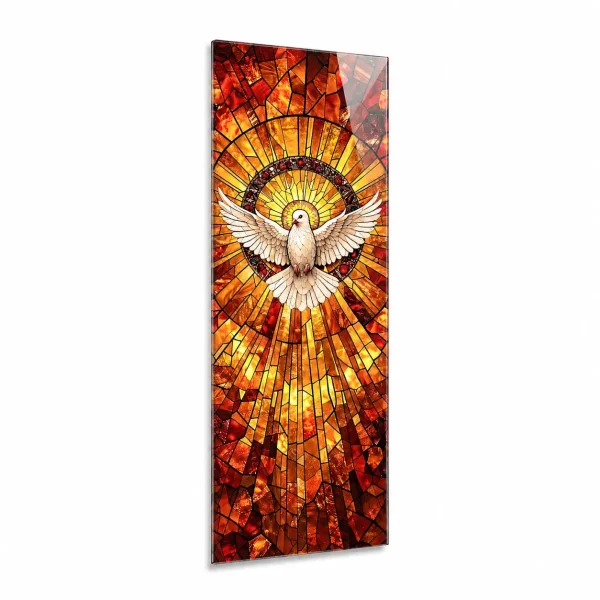
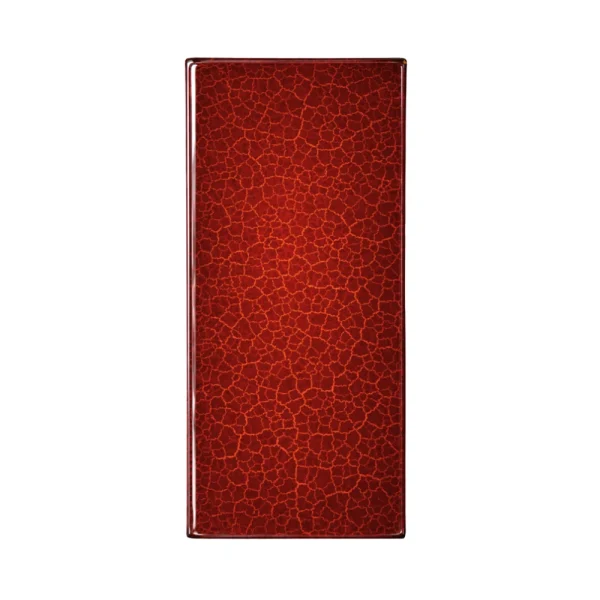
The six that go into a quotation most often — each picture opens the product:

Frequently asked questions

Do families really pay extra for glass?
They do when they have seen it in the hand and heard the offer before the price of the memorial was named. Proposed after the quotation, it reads as a surcharge and almost always falls away.

What realistically stays on one element?
€160 to €390, depending on whether it is mechanism A, B or C and how much markup you add. On two elements, €260 to €520.

Do you really save on stone?
Only when the memorial is designed with glass from the start and the stele is narrower or split. Cutting an opening in a finished slab saves nothing.

Single-sided or double-sided heart?
Single-sided on a standard memorial — less work for the same effect from the front. Double-sided where the memorial really is seen from both sides, with the slab preparation written into the quotation.

8 mm or 20 mm panel?
The fixing chooses the thickness. 8 mm on the face of the slab, 20 mm into a plinth or channel. The light-transmitting version only makes sense when it is set in.

Is coloured glass allowed in a churchyard?
Not automatically. Diocesan regulations usually put coloured decoration outside what the incumbent can approve alone, so it needs a faculty; council cemeteries are generally more relaxed. Check before you quote it.

What is the trade discount?
Partner prices show once you are logged in to a trade account; terms are agreed individually on the cooperation page. The discount is, though, the smallest part of this sum.

Do we have to hold stock?
No. Everything is made to order, in about 3–6 weeks, with a design to approve in two or three days.

The crib sheet

  1. Three mechanisms: A glass instead of stone (20 mm panels), B glass on stone (8 mm, 10 mm hearts, large photographs), C glass in the mass (20 mm hearts, crosses).
  2. A and B earn on their own. C earns if the labour made it into the quotation.
  3. The stone saving exists only when the memorial is designed with glass from the start.
  4. The trade discount is the floor. The earning is the markup on an element nobody can price against.
  5. Single-sided heart against double-sided — the difference in work is bigger than the difference in price.
  6. Panel 20 × 55 cm: 8 mm on the face of the slab, 20 mm into a plinth.
  7. Large photograph 40 × 50 cm — the biggest effect for the simplest fixing.
  8. Always offer before naming the price, always a sample in the hand, always a flexible joint.
Working with masonsGet in touch with us

We will work out together what your typical jobs leave, and put together a starter set matched to what you sell most.

+48 789 024 384biuro@deseomemorials.com
Share this article

← All posts